
Vishwarupa Darshana Yoga: Universal Form of Bhagwan Krishna in Bhagavad Gita Chapter 11
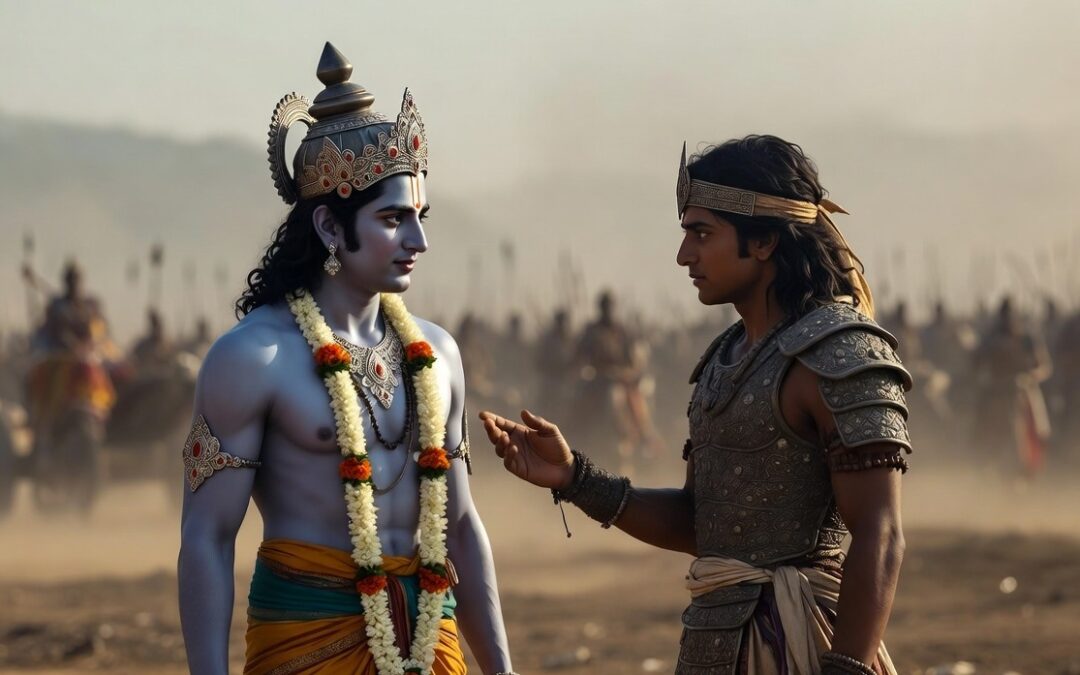
Imagine standing on the vast battlefield of Kurukshetra, conch shells echoing, arrows whistling through the air, and two mighty armies facing each other like oceans ready to clash. In the middle of this chaos sits Arjuna, the greatest warrior of his time, suddenly overcome by doubt and sorrow. His chariot is guided by none other than Bhagwan Krishna, his beloved friend and charioteer. Arjuna has just heard profound teachings on duty, knowledge, and devotion. Yet something deeper stirs in his heart. He longs to see the true glory of the one who has been guiding him all along.
This is the setting for Chapter 11 of the Bhagavad Gita, known as Vishwarupa Darshana Yoga – the Yoga of the Vision of the Universal Form. It is one of the most dramatic and awe-inspiring chapters in the entire scripture. Here, Bhagwan Krishna reveals His cosmic form, showing that He is not just a friend or a guide, but the very source and substance of the entire universe. Let us journey through this chapter together, like a curious child listening to an ancient tale by the fireside, while also uncovering its deep wisdom for our busy modern lives.
The Curious Request of Arjuna
After listening to Bhagwan Krishna describe His divine glories in the previous chapter (Vibhuti Yoga), Arjuna feels a surge of devotion mixed with wonder. He says humbly:
“O Lord, You have kindly spoken to me about the supreme secret of the Self. My delusion is gone. But now, if it is possible, I wish to see Your divine universal form, O Supreme Being.”
Arjuna is not demanding a miracle out of pride. His heart is pure. He has heard that Bhagwan Krishna is the eternal, imperishable reality behind everything. Now he wants to experience it directly, not just with words but with vision. This request comes from a place of sincere longing – the same longing many of us feel when we wonder, “Is there really something greater than what my eyes can see?”
Bhagwan Krishna smiles with compassion. He knows that ordinary human eyes cannot behold such a sight. So, He grants Arjuna divya chakshu – divine vision. It is like giving special spectacles that allow one to see beyond the physical world into the spiritual reality. This divine sight is not magic for entertainment; it is grace earned through devotion and surrender.
The Magnificent Revelation of Vishwarupa
Suddenly, the scene transforms. Sanjaya, the narrator who is describing everything to the blind King Dhritarashtra far away, says that Bhagwan Krishna, the great master of yoga, reveals His Vishwarupa – the universal form.
What does Arjuna see? Words can hardly capture it, yet the Gita paints a vivid picture. The form has countless faces, eyes, mouths, and arms stretching in every direction. It contains the entire creation – moving and non-moving beings, gods, sages, planets, stars, suns, and moons. Arjuna sees all the worlds united in one single body. The brilliance is like a thousand suns rising at once in the sky. Divine garlands, ornaments, and scents fill the air. It is both terrifying and beautiful, infinite and all-encompassing.
Arjuna exclaims in wonder and fear:
“I see You with infinite arms, stomachs, faces, and eyes. O Lord of the universe, whose form is the universe itself, I do not see any beginning, middle, or end to You.”
He witnesses warriors from both armies rushing into the mouths of this cosmic form, like moths flying into a blazing fire. Time itself seems to be devouring everything. Bhagwan Krishna declares:
“Kalo ’smi loka-kshaya-krit pravriddho – I am Time, the destroyer of worlds, grown mature and engaged in destroying all people.”
This is a powerful reminder of impermanence. No one escapes the cycle of creation, preservation, and dissolution. Even the greatest heroes are part of this cosmic dance. Arjuna sees his teacher Drona, grandsire Bhishma, and other warriors being consumed. The vision shakes him to the core.
Arjuna’s Prayer and the Return to the Gentle Form
Overwhelmed by awe, trembling with fear and devotion, Arjuna folds his hands and prays:
“O Lord, I am frightened by seeing this terrible form of Yours. Please show me Your pleasing, four-armed form again – the one I am familiar with.”
He offers heartfelt praises, calling Bhagwan Krishna the father, mother, and friend of the universe. He begs for forgiveness if he has ever spoken casually to Him as a friend, not realizing His true glory.
Bhagwan Krishna, ever compassionate, withdraws the terrifying Vishwarupa. First, He appears in His four-armed form as Bhagwan Vishnu – holding the conch, discus, mace, and lotus. Then, He gently returns to His charming two-armed form as the beloved Krishna, smiling reassuringly.
He explains that this universal form is extremely rare to behold. Even the gods long to see it, but it is granted only through pure devotion. No amount of study, rituals, or austerities alone can reveal it – only bhakti (loving devotion) can.
Key verse (11.54):
“Bhaktya tvananyaya shakya aham evam-vidho ’rjuna – Only through undivided devotion can I be seen in this form, O Arjuna.”
Deeper Insights from Scriptures
The Vishwarupa Darshana connects beautifully to other ancient texts. In the Puranas, Bhagwan Vishnu reveals similar cosmic forms – for example, as Vamana (the dwarf incarnation), He expands to cover the entire universe in three steps to humble King Bali. The Vedas and Upanishads speak of Brahman as the infinite reality in which the whole cosmos exists like a spider’s web within the spider. The Ramayana and Mahabharata echo this idea that the Divine is both personal (loving friend) and impersonal (cosmic order).
A lesser-known fact: This vision is not just for Arjuna. Sanjaya also sees it through the grace of Sage Vyasa. It reminds us that divine grace can reach sincere hearts even from afar.
The chapter links to dharma (righteous duty) and karma (action). Arjuna learns that the war’s outcome is already part of the cosmic plan. His role is to act as an instrument without attachment. This dissolves ego and fear, teaching us to perform our duties while remembering we are part of something much larger.
Significance and Relevance to Modern Life
In today’s fast-paced world, where we often feel small and overwhelmed by stress, deadlines, and global challenges, Vishwarupa Darshana offers profound comfort and perspective.
- Interconnectedness: Everything and everyone is part of one divine reality. When we hurt others, we hurt the whole. When we help, we serve the cosmic order. This inspires empathy, environmental care, and unity beyond differences.
- Impermanence and Acceptance: “I am Time, the destroyer” teaches us to accept change. Jobs end, relationships transform, bodies age – but the eternal Self remains untouched. Practically, this reduces anxiety. Try this simple tip: When facing difficulty, pause and remind yourself, “This too is part of the larger cosmic play. I will do my best and surrender the rest.”
- Beyond Ego: Arjuna’s fear shows how even a brave warrior trembles before the infinite. In daily life, when pride or fear arises, remember the Vishwarupa. It humbles us and encourages selfless action (nishkama karma).
- Devotion as the Key: The chapter beautifully balances knowledge with love. Intellectual understanding is good, but heartfelt devotion opens the door to divine vision. Many people today practice mindfulness or meditation – adding a touch of bhakti, like chanting or offering gratitude, can deepen the experience.
Practical Applications:
- Start your day visualizing the world within the Divine (or the Divine within the world).
- When angry or worried, recall Arjuna’s prayer and offer it to Bhagwan Krishna.
- In decision-making, ask: “Am I acting as an instrument of dharma, or driven by ego?”
Related Rituals, Mantras, and Do’s and Don’ts
While there is no specific ritual only for Vishwarupa, devotees often read or chant Chapter 11 on auspicious days like Janmashtami (Krishna’s birthday) or during Gita Jayanti. Many temples display artistic depictions of the Vishwarupa for darshan.
A powerful mantra from the chapter or related to Krishna is the Mahamantra:
Hare Krishna Hare Krishna, Krishna Krishna Hare Hare Hare Rama Hare Rama, Rama Rama Hare Hare
Or simply repeat: Om Namo Bhagavate Vasudevaya (salutations to Bhagwan Krishna, son of Vasudeva).
Do’s:
- Read the Gita with devotion and reflection.
- Cultivate humility and surrender.
- See divinity in all beings and nature.
Don’ts:
- Do not approach scriptures with mere curiosity or ego.
- Avoid treating the Divine as ordinary without reverence.
- Never use spiritual visions for personal power or show.
Regional variations exist – in South India, elaborate Vishwarupa paintings adorn temple walls; in North India, devotional songs (bhajans) narrate Arjuna’s wonder during festivals.
Scientific parallels? Modern physics speaks of a unified field or interconnected universe (quantum entanglement). The ancient vision of everything existing within one form resonates with ideas of cosmic unity, though the Gita’s emphasis is spiritual, not material.
Benefits – Spiritual, Everyday, and Timeless
Spiritually, beholding or even contemplating the Vishwarupa awakens awe, dissolves fear of death, and leads toward liberation (moksha). It strengthens faith that the Divine is always present, supporting us.
In everyday life, it brings peace amid uncertainty. Studies on gratitude and awe (similar to Arjuna’s experience) show reduced stress and increased well-being. Karmically, it encourages right action without attachment, improving relationships and inner harmony.
Globally, the message of universal oneness promotes harmony across cultures. On Janmashtami or Gita celebrations worldwide, people from all backgrounds find inspiration in this chapter.
An Uplifting Spiritual Message
Dear reader, the Vishwarupa Darshana is not just an ancient story – it is an invitation. Bhagwan Krishna tells us that the entire universe is His form, yet He is also the gentle friend who loves us unconditionally. In moments of doubt, like Arjuna on the battlefield, turn inward. Offer your fears, your duties, and your love at His feet.
Remember: You are never alone. The same infinite power that holds the stars holds your hand. Act with dharma, live with devotion, and one day, through grace, your eyes too may open to the divine glory all around.
May the timeless wisdom of Vishwarupa Darshana Yoga fill your heart with peace, courage, and universal harmony. Let us carry this vision into our daily lives – seeing the sacred in the ordinary, the infinite in the finite, and love in every breath.
Jai Shri Krishna!
What to read next:
- How the Guru of Asuras Mastered Sanjeevani Vidya to Defy Death
- Is Ramayana Real History? Archaeological, Astronomical & Spiritual Evidence
- How Krishna’s Glories Can Transform Your Daily Life Forever
Support us by purchasing from our Affiliate Links:
Hanuman Chalisa by Shubha Vilas | Experience the Power and Blessings of Lord Hanuman