
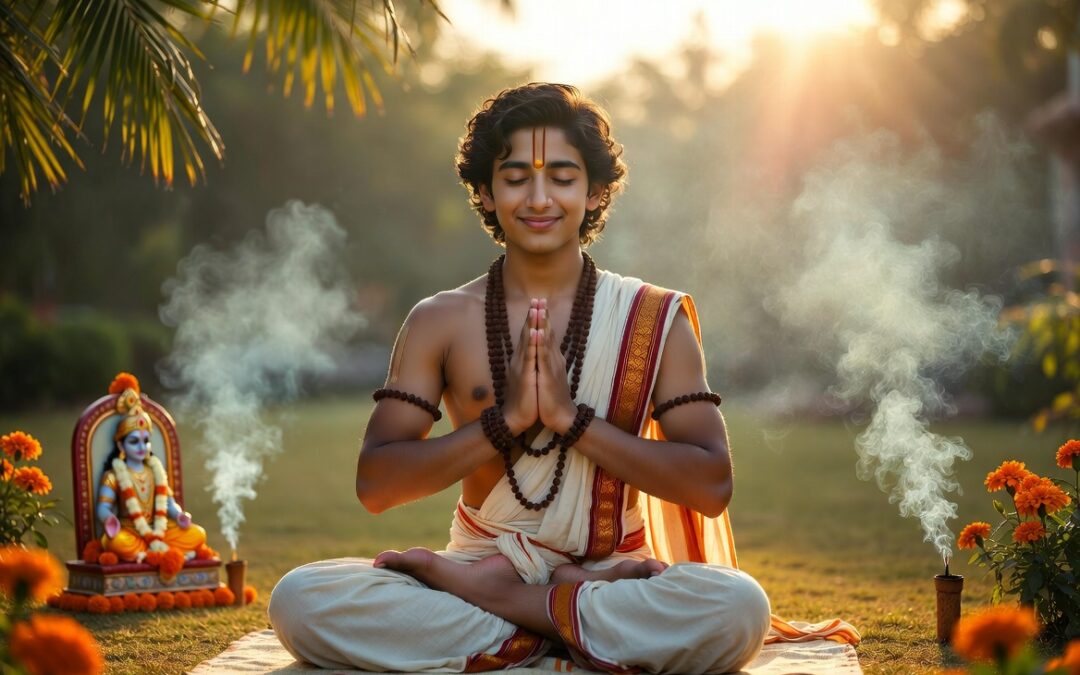
Unveiling the Divine Spark: A Journey into Vibhuti Yoga – The Yoga of Infinite Glories
Imagine standing on a misty mountain peak at dawn, the first rays of the sun painting the sky in hues of gold and pink. As the light touches the snow-capped Himalayas, you feel a quiet awe – a whisper that something vast and beautiful holds it all together. What if I told you that this moment isn’t just nature’s magic, but a glimpse of the divine? In the ancient wisdom of the Bhagavad Gita, Bhagwan Krishna shares exactly this secret with his dear friend Arjuna. It’s a conversation that turns confusion into wonder, fear into faith. Welcome to Vibhuti Yoga, the Yoga of Divine Glories – Chapter 10 of the Gita – where the Supreme Lord reveals how His infinite splendor shines through every leaf, every virtue, every breath of life.
This isn’t just a dry lesson from scriptures; it’s an invitation to see the world as a canvas of the divine. Whether you’re a young explorer curious about spirituality or someone seeking deeper meaning amid life’s hustle, Vibhuti Yoga offers a map to rediscover joy in the ordinary. Let’s walk through this chapter together, like friends sharing stories by a campfire, uncovering how these glories can light up our modern days.
The Battlefield of the Mind: Setting the Stage for Vibhuti Yoga
Picture the Kurukshetra battlefield, where chariots rumble and arrows fly. Arjuna, the mighty warrior, slumps in despair, his bow slipping from his hands. How can he fight his own kin? Into this turmoil steps Bhagwan Krishna, his charioteer and guide, not with commands, but with timeless truths. In the previous chapter, Krishna has painted a picture of unwavering devotion – bhakti – as the highest path. But Arjuna’s heart still wavers. He needs something tangible, something to hold onto.
That’s where Vibhuti Yoga enters, like a burst of sunlight after a storm. The word “vibhuti” comes from Sanskrit roots meaning “manifestation” or “supreme power.” It’s not about abstract philosophy; it’s Krishna showing Arjuna (and us) that the divine isn’t far-off in the clouds. No, Bhagwan Krishna is the thread weaving through every grand and gentle thing. This chapter, spanning 42 shlokas (verses), builds on the Gita’s core – the Mahabharata’s epic dialogue – drawing from deeper wells like the Vedas and Upanishads, where the One Reality pulses in all forms.
Historically, the Gita is said to echo the Vedic hymns praising the cosmic order (rita), where the divine powers sustain creation. In the Puranas, too, we see echoes – think of how Bhagwan Vishnu’s avatars embody these glories on earth. But here, Krishna makes it personal: “Arjuna, my beloved, listen once more,” He begins (Gita 10.1), like an elder storyteller drawing you closer. This yoga isn’t a separate practice like hatha or raja yoga; it’s the art of recognizing divinity to fuel your devotion, turning everyday sights into stepping stones for the soul.
Also read: Raja Vidya Secrets Revealed: How Gita’s King of Knowledge Brings Modern Harmony and Healing
Krishna’s Grand Revelation: Key Verses That Spark Wonder
At its heart, Vibhuti Yoga is Krishna’s loving response to Arjuna’s plea: “Tell me of Your divine powers, O Lord, so I may meditate on You always” (Gita 10.16-18). Arjuna isn’t doubting; he’s hungry for more, like a child asking, “Why is the sky blue?” Krishna obliges, starting with His eternal nature.
“Neither the gods nor the great sages know My origin,” Krishna declares (Gita 10.2). Imagine that – even Indra or wise rishis like Narada can’t grasp the full mystery! He explains He’s the unborn source, the beginningless Lord of all (10.3). Those who truly know this escape illusion’s grip, freed from life’s tangled webs of good and bad.
Then comes a beautiful cascade: All human qualities flow from Him. Intellect, knowledge, forgiveness, truthfulness, control over senses, joy and sorrow, fear and courage, non-violence, equanimity – even austerity, charity, fame, and infamy (Gita 10.4-5). It’s like Krishna saying, “Look inside yourself; that’s Me too.” This ties straight to karma – our actions and their echoes – because these traits shape how we live dharma, the righteous path. A forgiving heart? Divine gift. A moment of courage? Krishna’s quiet nudge.
The chapter’s magic unfolds in lists of vibhutis – specific shines of the divine. “I am the source of all; everything arises from Me,” Krishna says (10.8). Devotees who fix their minds on Him find endless bliss, chatting about His wonders like old friends (10.9). And the promise? To the devoted, He gifts buddhi-yoga – the intelligence to see truth – and lights the lamp of knowledge in their hearts, banishing ignorance’s shadows (10.10-11).
Arjuna responds with awe: “You are the Supreme Brahman, the eternal refuge” (10.12). It’s a moment of surrender, reminding us that true growth blooms in humility.
Stories from the Stars: Myths That Bring Vibhutis to Life
The Gita doesn’t spin long tales here, but its verses are seeds for ancient myths that illustrate these glories. Take the sun, one of Krishna’s prime vibhutis: “Among all luminaries, I am the radiant sun” (10.21). Remember the story from the Rig Veda, where Surya, the sun god, rises each dawn as a chariot pulled by seven horses, chasing away darkness? It’s no myth of might alone; it’s dharma in action, lighting the path for all beings. Just as the sun warms without favor, Krishna’s glory sustains us equally.
Or consider the Himalayas: “Of mountains, I am the Himalayas” (10.23). In the Ramayana, these peaks cradle the ashram of sage Valmiki, where young Lava and Kush learn of Bhagwan Rama’s adventures. The mountains stand unmoved, symbols of steadfast dharma amid storms – much like how Vibhuti Yoga teaches us to root in the divine during life’s upheavals.
A lesser-known gem connects to the Bhagavata Purana: The Vamana avatar. Bhagwan Vishnu, as a dwarf brahmin, asks King Bali for three steps of land. With two strides, He covers earth and heavens; the third? Bali offers his head, earning eternal grace. Here, Krishna’s glory humbles the mighty, showing vibhuti isn’t about showy power but humble surrender. It’s a nod to karma too – Bali’s generosity reaps divine favor, turning defeat into devotion.
And Hanuman from the Ramayana? He embodies Krishna’s vibhuti as “the wind among the purifiers” (10.31). Swift, devoted, Hanuman leaps oceans for Bhagwan Rama, seeing the divine in service. These stories aren’t dusty legends; they’re mirrors, reflecting how we can spot Krishna’s spark in our own leaps of faith – a parent’s selfless love, an athlete’s unyielding spirit.
Also read: The Ultimate Guide to Chanting Hanuman Chalisa Daily
The Infinite List: Where Divinity Dances in Creation
Krishna doesn’t stop at words; He paints pictures. “Whatever is glorious, beautiful, or mighty, know it springs from a fraction of My splendor” (10.41). Here’s a glimpse of His vibhutis, grouped like treasures in a cosmic chest – perfect for meditation, one at a time.
Glories in the Cosmos and Nature
- Among the Adityas (solar deities): I am Bhagwan Vishnu (10.21).
- Among lights: The blazing sun.
- Among stars: The moon, queen of the night.
- Among rivers: The sacred Ganges, flowing with purity.
- Among mountains: The mighty Himalayas, guardians of the earth.
- Among seasons: The blooming spring.
- Among purifying forces: The swift wind.
These remind us: Next time you watch a sunset, whisper thanks – it’s Krishna’s glow.
Shines in Beings and Virtues
- Among warriors: Bhagwan Rama, wielder of the bow.
- Among sages: Ved Vyasa, composer of epics.
- Among leaders: The rightful king.
- Among animals: The lion, king of the jungle.
- Among birds: Garuda, the eagle of devotion.
- Human gifts: Truthfulness, forgiveness, courage – all from Me (10.4-5).
In virtues, it’s profound: Non-violence? Krishna’s gentle hand. Contentment? His quiet peace.
Echoes in Knowledge and Time
- Among Vedas: The Sama Veda, melody of the soul.
- Among sounds: The sacred Om.
- Among letters: The primal “A.”
- Among measures of time: The endless flow.
- Among debates: The winning argument of truth.
Krishna wraps it: “By a mere fraction of Myself, I support this vast universe” (10.42). It’s humbling – infinity in the finite, like stars in a dewdrop.
Why It Matters Today: Weaving Divine Glories into Daily Life
In our fast-scrolling world, where stress buzzes like a relentless bee, Vibhuti Yoga is a reset button. It shifts us from “me-first” to “all-is-divine,” fostering spiritual awakening by dissolving the ego’s walls. See a kind stranger? That’s Krishna’s forgiveness shining. A storm’s fury? His power in balance. This vision curbs karma’s chains – fewer attachments mean lighter actions, aligned with dharma’s flow.
Practical Tips to Practice Vibhuti Yoga:
- Morning Meditation: Sit quietly, pick one vibhuti – say, the sun. Visualize Krishna’s warmth filling you. Breathe: “Inhale glory, exhale doubt.” (5-10 minutes daily builds focus.)
- Gratitude Walks: Stroll in a park, naming glories: “This tree’s strength? Divine. This flower’s bloom? Joy from Him.” Turns routine into ritual.
- Journal Sparks: End your day listing three “glory sightings” – a child’s laugh, a solved puzzle. Sparks devotion, like Arjuna’s awe.
- Share the Light: Discuss a verse with friends, as devotees do (10.9). Apps or Gita study groups make it easy.
Benefits Across the Board:
- Spiritual: Deepens bhakti, leading to inner peace and God-realization.
- Everyday: Boosts resilience – fear fades when you see divine hands in challenges.
- Scientific Nod: Modern psychology echoes this; gratitude practices (like spotting “glories”) reduce anxiety, per studies on mindfulness.
Regional twists? In South India, Tamil saints like Alwars sang of Vishnu’s vibhutis in Divya Prabandham. Globally, Krishna’s festival in Bali blends with local dances, celebrating universal harmony.
Do’s and Don’ts for the Path:
- Do: Chant “Om Namo Bhagavate Vasudevaya” while reflecting on a vibhuti – it attunes the mind.
- Don’t: Let lists overwhelm; start small, let wonder grow naturally.
- Do: Offer actions to Krishna before starting work – “This effort for Your glory.”
- Don’t: Claim virtues as “mine”; humbly trace them back to the Source.
Deeper Waters: Lesser-Known Ties to Cosmic Wisdom
Dig a little, and Vibhuti Yoga links to the Upanishads’ “Tat Tvam Asi” – Thou art That. A hidden fact: The seven rishis born from Krishna’s mind (10.6) are the Saptarishis of the Ursa Major constellation, guiding navigators for millennia – divine GPS for the soul! It connects karma to cosmic order: Virtues like charity ripple as positive seeds, while recognizing glories awakens jnana, the knowledge that shatters rebirth’s cycle.
In the Mahabharata, Yudhishthira’s unyielding truth (a vibhuti) saves his brothers from Yaksha’s test – dharma’s glory in disguise. For awakening, it’s buddhi-yoga’s gift: Discern eternal from fleeting, like spotting gold in sand.
A Timeless Whisper: Harmony in Every Heartbeat
As the Gita’s sun sets on this chapter, Krishna leaves us with hope: His glories are endless, a mere spark sustaining all (10.40). In a divided world, Vibhuti Yoga calls us to unity – see the divine in every face, every flower, and find peace in that shared light. Let it inspire you: Surrender like Arjuna, meditate like the rishis, live with the joy of knowing you’re held by infinite love. In this dance of glories, may your heart bloom eternal harmony, echoing the Gita’s song: All is One, and One is All.
Support us by purchasing from our Affiliate Links:
Hanuman Chalisa by Shubha Vilas | Experience the Power and Blessings of Lord Hanuman