
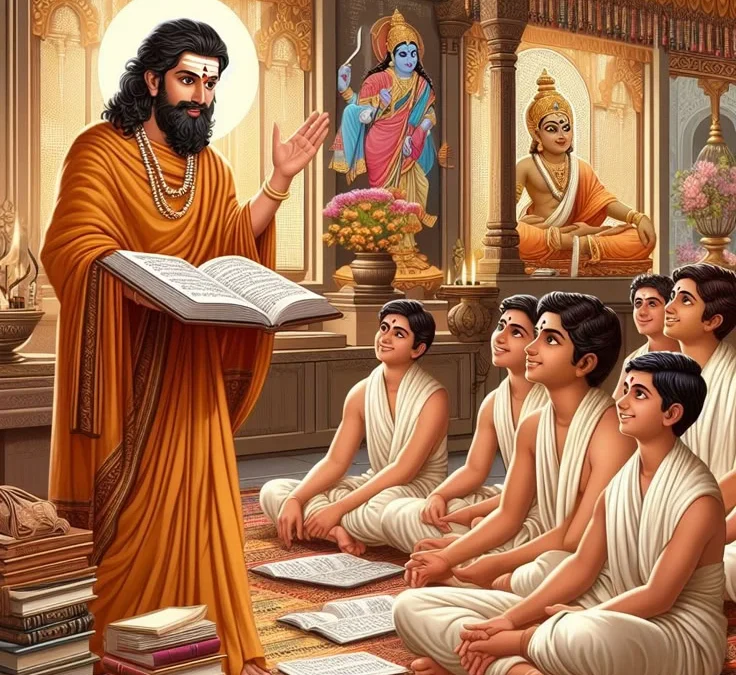
Why the Bhagavad Gita is Called the Song of God
The Bhagavad Gita, often simply called the Gita, holds a special place in Hindu philosophy and spirituality. It’s not just a book; it’s a timeless guide that has inspired millions across the world for centuries. But why is it known as the “Song of God”? To understand this, we need to dive into its origins, context, and deeper meanings. In this blog, I’ll explain everything step by step, starting with some background on who Bhagwan (God) is in this context, why the Gita was composed, and then explore the reasons behind its poetic title.
Understanding the Context: Who is Bhagwan and the Roots of the Bhagavad Gita
First, let’s clarify the term “Bhagwan.” In Hinduism, Bhagwan refers to the Supreme Being or God, often embodying qualities like omnipotence, omniscience, and infinite compassion. In the Bhagavad Gita, Bhagwan specifically points to Lord Krishna, who is considered an avatar (incarnation) of Vishnu, the preserver in the Hindu trinity (Brahma the creator, Vishnu the preserver, and Shiva the destroyer). Krishna is not just a historical figure but a divine manifestation who descends to Earth to restore dharma (righteousness) when chaos reigns.
The Bhagavad Gita is embedded within the epic Mahabharata, one of India’s two major Sanskrit epics (the other being the Ramayana). The Mahabharata, attributed to the sage Vyasa, narrates the story of a great war between two branches of a royal family: the Pandavas and the Kauravas. This war symbolizes the eternal battle between good and evil, dharma and adharma.
Why was the Gita composed? It wasn’t “constructed” like a building but revealed as a divine dialogue at a critical moment. The setting is the battlefield of Kurukshetra, where the Pandava prince Arjuna is about to fight his cousins, teachers, and friends. Overwhelmed by doubt and grief, Arjuna throws down his weapons, refusing to battle. He questions the point of victory if it means killing his own kin. This is where Krishna, serving as Arjuna’s charioteer and guide, steps in. The Gita is essentially Krishna’s response to Arjuna’s crisis—a profound conversation that addresses life’s biggest questions: duty, morality, the nature of the soul, and the path to liberation.
The Gita was “composed” around 2,000 to 5,000 years ago, though exact dates are debated. Scholars place it between the 5th century BCE and the 2nd century BCE. It’s part of the Bhishma Parva (section) in the Mahabharata. Vyasa is said to have compiled the epic, but the Gita’s words are divine revelation, spoken by Krishna himself. In Hindu belief, such texts aren’t human inventions but eternal truths (sanatana dharma) that sages perceive through meditation and divine grace. The Upanishads, which are philosophical endings to the Vedas, lay the groundwork for the Gita’s ideas, emphasizing concepts like Brahman (the ultimate reality) and Atman (the individual soul).
This context is crucial because the Gita isn’t a standalone religious text; it’s a practical manual for living amid conflict. It was “constructed” or revealed to help humanity navigate moral dilemmas, much like how the Vedas were chanted to invoke cosmic order.
Why is it Called the “Song of God”?
Now, to the heart of the matter: Why “Song of God”? The name “Bhagavad Gita” breaks down into two Sanskrit words. “Bhagavad” comes from “Bhagavan,” meaning “the Blessed One” or “God,” referring to Krishna. “Gita” means “song” or “that which is sung.” So, literally, it’s the “Song of the Lord” or “Song of God.”
But why “song”? Isn’t it a philosophical discourse? Yes, but in ancient Indian tradition, sacred knowledge was often transmitted through poetry and melody. The Gita consists of 700 verses (shlokas) written in the Anushtup meter, a rhythmic poetic form that’s easy to memorize and chant. It’s designed to be sung, not just read, which makes it accessible and memorable. Imagine ancient sages reciting it around a fire, their voices rising and falling like a melody—this musical quality elevates it from mere words to a divine symphony.
The “song” aspect also symbolizes harmony. Just as a song blends notes into a cohesive whole, the Gita harmonizes various paths of yoga: Karma Yoga (path of action), Bhakti Yoga (path of devotion), Jnana Yoga (path of knowledge), and even Raja Yoga (path of meditation). Krishna sings this wisdom to Arjuna, tuning his confused mind to the rhythm of the universe.
Moreover, in Hindu lore, God often communicates through song. The Vedas are “shruti” (that which is heard), revealed as divine sounds. The Upanishads speak of the cosmic vibration “Om” as the primal song. Krishna himself is depicted as a flute player in the Bhagavata Purana, enchanting the world with his music. Calling the Gita a “song” underscores its divine origin—it’s not human philosophy but God’s direct melody, meant to resonate in our hearts.
One lesser-known reason is the Gita’s emotional depth. Like a heartfelt song, it evokes feelings of surrender, love, and peace. Arjuna starts in despair but ends enlightened, much like how a sad ballad can uplift the soul. This emotional pull has made it a “song” that transcends time, influencing figures like Mahatma Gandhi, who called it his “spiritual dictionary,” and even modern thinkers like Albert Einstein, who praised its insights.
Also read: The Power of Dharma: How Duty and Righteousness Shape a Meaningful Life
Delving Deeper: Key Teachings and Philosophical Insights
To fully appreciate why it’s the Song of God, let’s explore its core messages. The Gita spans 18 chapters, each building on the last, like verses in a grand composition.
Chapter 1-2: The Crisis and the Immortal Soul
Arjuna’s dilemma sets the stage. Krishna begins by explaining the soul’s immortality: “The soul is neither born nor does it die; it is eternal” (Chapter 2, Verse 20). Drawing from the Upanishads, like the Katha Upanishad, which compares the body to a chariot, Krishna urges Arjuna to fight as his dharma (duty) without attachment to results. This detachment is key—perform actions but surrender fruits to God.
Karma Yoga: The Path of Selfless Action
In Chapters 3-5, Krishna sings of Karma Yoga. “You have a right to perform your prescribed duty, but you are not entitled to the fruits of action” (2:47). This prevents ego from tainting deeds. It’s practical advice: In today’s world, think of it as working hard without obsessing over promotions. The Gita warns against inaction too—true renunciation is internal, not external.
Bhakti Yoga: Devotion as the Sweetest Melody
Chapters 7-12 emphasize devotion. Krishna reveals his universal form (Vishvarupa) in Chapter 11, a awe-inspiring vision where Arjuna sees the entire cosmos in Krishna’s body. “Offer unto me all your actions, with mind fixed on me” (9:27). Bhakti is inclusive—anyone, regardless of caste or background, can attain God through love. This echoes the Bhakti movement in later Hinduism, inspired by saints like Mirabai.
Jnana Yoga: Knowledge of the Self
The Gita delves into metaphysics, explaining Prakriti (nature) and Purusha (spirit). It classifies knowledge into sattva (pure), rajas (passionate), and tamas (ignorant). True knowledge sees unity in diversity: “A learned person sees the same in a Brahmin, a cow, an elephant, a dog, and an outcast” (5:18). This non-dualistic view aligns with Advaita Vedanta from the Upanishads.
The Gunas and the Field-Knower
Chapter 13 introduces the “field” (body-mind) and the “knower of the field” (soul). The three gunas (qualities)—sattva, rajas, tamas—influence everything. Rising above them leads to liberation (moksha). Krishna’s song here is a call to self-awareness, much like mindfulness practices today.
The Supreme Goal: Surrender to God
The Gita culminates in Chapter 18 with “Sarva dharman parityajya mam ekam sharanam vraja” (18:66)—Abandon all duties and surrender to me; I will liberate you. This ultimate verse is the crescendo of the song, promising divine grace.
What makes the Gita unique is its synthesis. Unlike the abstract Upanishads or ritualistic Vedas, it’s relatable—set on a battlefield, mirroring our inner battles. It influenced the Sikh Guru Granth Sahib and even Western philosophy, like Schopenhauer’s ideas.
Also read: How the Bhagavad Gita Shapes Hindu Culture and Daily Life
Relevance Today and Lesser-Known Aspects
In modern times, the Gita’s “song” helps with stress, ethics, and purpose. During World War II, it guided leaders; today, it’s in yoga classes and management books. A lesser-known fact: The Gita mentions environmental harmony, urging balance with nature (5:21). It also promotes gender equality in spirit—souls have no gender.
Another insight: The Gita isn’t dogmatic. Krishna says, “As all surrender unto me, I reward them accordingly” (4:11), respecting diverse paths. This pluralism is vital in our divided world.
The Gita’s influence extends to art—it’s been adapted into dances, films like “Mahabharata,” and music by composers like Philip Glass.
Conclusion: The Eternal Melody
The Bhagavad Gita is called the Song of God because it’s Krishna’s divine poetry, sung to uplift humanity. Its rhythmic verses, profound wisdom, and emotional resonance make it a eternal tune that harmonizes life’s chaos. Whether you’re facing personal doubts like Arjuna or seeking spiritual depth, the Gita offers guidance. As the Vedas say, truth is one, but sages call it by many names—the Gita is one such beautiful name.
Support us by purchasing from our Affiliate Links:
Bhagvad Gita As It Is English New Edition
Spiritual Secrets from Hinduism: Essence of the Vedic Scriptures