
The Gentle Whisper of the Soul: Why Satsang is Your Secret Weapon towards the Path to Inner Growth
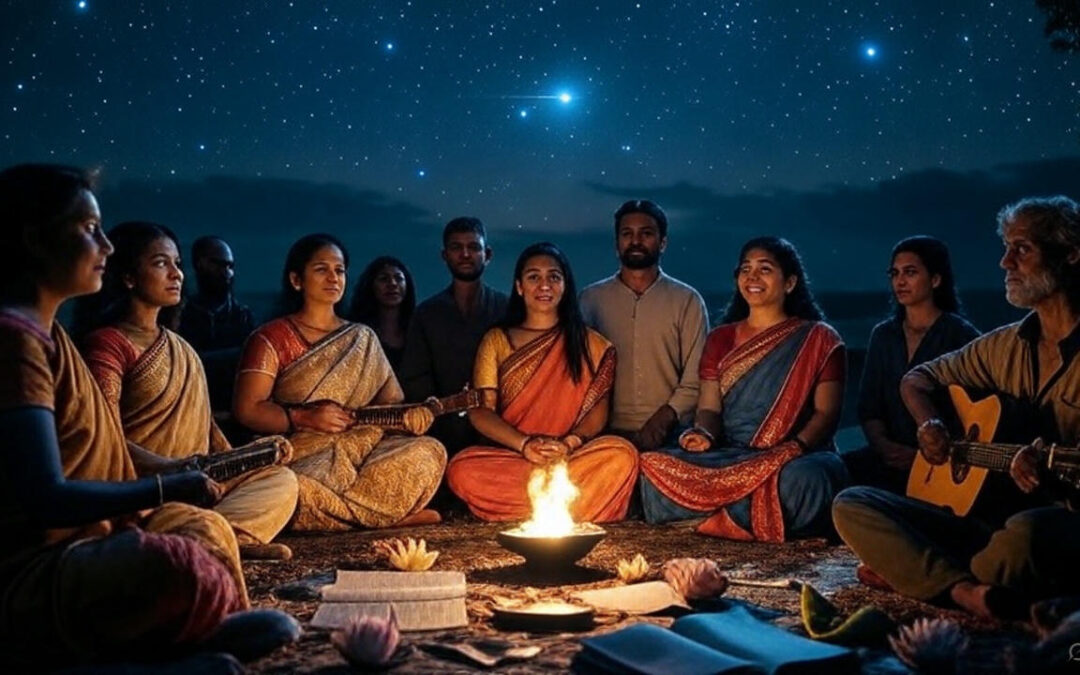
Imagine a quiet evening in a small village, where the sun dips below the horizon like a weary traveler seeking rest. Lamps flicker to life, casting golden halos on faces gathered in a simple hall. Soft voices rise in song, weaving tales of ancient sages and divine leelas—playful acts of the cosmos. No one speaks of worries; instead, hearts open like lotus flowers at dawn. This is satsang, a spiritual gathering that feels less like an event and more like coming home to your truest self. In our fast-spinning world of endless notifications and hurried steps, satsang stands as a timeless anchor, inviting us to pause, listen, and grow from within.
But what if I told you that this simple act of coming together could unravel the knots of doubt in your mind, spark a quiet fire of devotion in your heart, and even ripple out to heal the world around you? Satsang isn’t just a tradition—it’s a bridge between the ordinary and the divine, a gentle reminder that we’re all threads in the grand tapestry of existence. As we journey through this exploration, we’ll uncover its roots in sacred texts, relive enchanting stories from our granths, and discover how it blooms in modern lives. Whether you’re a young seeker dipping your toes into spirituality or a seasoned soul craving deeper waters, satsang offers something profound: the company of truth that nurtures the seed of inner growth.
Unveiling Satsang: A Timeless Tradition Rooted in Sacred Wisdom
At its heart, satsang—derived from “sat” meaning truth or the eternal essence, and “sang” meaning company—translates to the “company of truth.” It’s not merely sitting with friends or attending a lecture; it’s immersing in the presence of noble souls, wise teachers, or even the echo of divine words that elevate the spirit. Picture it as a sacred campfire where stories of dharma (righteous living) warm the soul, chasing away the chill of ignorance.
This practice traces its lineage to the earliest whispers of Hindu spirituality, embedded in the Vedas—the foundational hymns of cosmic order. The Rig Veda, with its verses on unity and harmony, hints at the power of collective praise, where voices unite to invoke higher realms. But it’s in the Upanishads, the philosophical gems at the Vedas’ close, that satsang truly shines. These dialogues between gurus and shishyas (teachers and disciples) under banyan trees or by riverbanks emphasize the guru’s role as a living embodiment of truth. The Chandogya Upanishad beautifully illustrates this: a father teaches his son through immersive experiences, showing how knowledge unfolds not in isolation, but in shared revelation. Here, satsang becomes the vessel for atma-jnana—self-knowledge—that dissolves the illusion of separateness.
Turning to the epics, the Mahabharata and Ramayana paint satsang as a lifeline amid chaos. In the Bhagavad Gita, nestled within the Mahabharata, Bhagwan Krishna imparts eternal wisdom to Arjuna on the battlefield of Kurukshetra. This isn’t a private chat; it’s a cosmic satsang, overheard by charioteers and warriors, reminding us that truth shared multiplies its grace. Krishna advises in Chapter 4, Verse 34: Approach the wise with humility, offer service, and inquire with devotion—they’ll illuminate the path. The Puranas, those vast oceans of myths and morals, echo this chorus. The Bhagavata Purana, devoted to Bhagwan Vishnu’s avatars, brims with tales of devotees flocking to saints, their gatherings dissolving ego like dew under the sun.
These scriptures aren’t dusty relics; they’re living maps to dharma and karma. Satsang aligns our actions with cosmic rhythm, teaching that every thought, word, and deed plants seeds for tomorrow’s harvest. In a world where karma often feels like an abstract idea, satsang grounds it: by surrounding ourselves with sattvic (pure) influences, we cultivate habits that lead to spiritual awakening, one shared breath at a time.
Also read: Unlock Inner Peace: Bhakti Yoga vs. Karma Yoga – Discover Your True Spiritual Calling
Enchanted Tales from the Granths: Stories That Breathe Life into Satsang
Nothing stirs the soul like a story, does it? Hindu granths are treasure troves of such narratives, each one a lantern illuminating satsang’s transformative magic. Let’s step into one lesser-known gem from the Mahabharata—the tale of Dharmavyadha, the ethical hunter. In the Vana Parva, the sage Kaushika, proud of his ascetic vows, once kills a bird out of anger. Shaken, he seeks counsel and wanders to a bustling market. There, a humble butcher named Dharmavyadha pauses his work for a profound satsang. Over simple words exchanged at a doorstep, the butcher reveals his life of selfless duty: he slays only for sustenance, honors his parents, and lives with unwavering integrity. Kaushika, the learned one, realizes true wisdom blooms in everyday devotion, not isolated penance. This encounter shatters his pride, urging him toward inner purity. It’s a whisper: Satsang finds you where you are, turning ordinary moments into divine lessons.
Then there’s the enchanting saga of Ratnakar, the dreaded dacoit who became Maharishi Valmiki, author of the Ramayana. Roaming forests, preying on travelers, Ratnakar lived in shadows until the sage Narada’s footsteps crossed his path. Challenged to meditate on “Rama,” he stumbles over the name, twisting it to “Mara” (death). Yet, in that raw satsang with the rishi—under a tree, hearts laid bare—repetition births miracle. Ants crawl over his unmoving form, weaving a valmika (anthill), from which he emerges enlightened. This myth underscores karma’s alchemy: even a hardened heart softens in truth’s company, birthing poetry that echoes through millennia.
From the Puranas comes the story of the hunter and the birds in the Bhagavata Purana. A cruel huntsman unwittingly aids a dying bird, his arrow piercing another in flight. Bhagwan Vishnu, disguised as a yogi, gathers devotees for satsang nearby. The hunter, drawn by the chants, listens unwittingly. His soul stirs; past sins dissolve like mist. Here, satsang’s grace extends beyond intent—it’s a cosmic current, pulling wanderers toward the divine shore.
These tales aren’t mere fables; they’re mirrors reflecting our own journeys. They connect satsang to the grand play of leela, where Bhagwan’s avatars like Rama and Krishna use gatherings to awaken dormant devotion. In lesser-known corners, like the Skanda Purana’s accounts of rishis in Himalayan hermitages, satsang fosters siddhis (spiritual powers) through collective tapas (austerity). Imagine the thrill: your quiet participation could be the spark for someone’s awakening, weaving you into eternity’s story.
The Blossoming Benefits: How Satsang Nurtures Body, Mind, and Spirit
Why seek satsang amid life’s hustle? The granths promise profound fruits, but let’s peel back the layers to see how they touch every facet of being.
Spiritual Harvests That Feed the Soul At its core, satsang dissolves tamas (inertia) and rajas (restlessness), ushering in sattva—clarity and peace. It strengthens bhakti (devotion), as shared kirtans (devotional songs) invoke Maa Lakshmi’s grace or Bhagwan Shiva’s serenity. Regular immersion builds resilience against maya (illusion), fostering atma-bodha (self-realization). A lesser-known insight: In the Yoga Vasistha, satsang is likened to a magnet drawing iron filings—souls align toward moksha (liberation), accelerating karma’s purification.
Everyday Elixirs for a Balanced Life Beyond the ethereal, satsang grounds us. It forges community bonds, combating modern loneliness like a warm embrace. Young readers, think of it as your spiritual squad: sharing laughs over bhajans or tears during discourses lightens burdens. It instills dharma in decisions—choosing kindness over haste—and cultivates gratitude, turning mundane chores into offerings.
Scientific Echoes in Ancient Wisdom Curious about bridges to science? Studies on group meditation, akin to satsang’s chanting, show reduced cortisol (stress hormone) levels, per research from institutions like Harvard. Collective resonance synchronizes brainwaves, enhancing empathy via mirror neurons. Neurologically, it boosts neuroplasticity, rewiring habits for positivity. Ayurveda echoes this: Satsang balances doshas (body energies), promoting holistic health. In trials on communal singing, participants report heightened oxytocin—”the love hormone”—fostering trust and joy.
Regionally, satsang varies like India’s vibrant mosaic. In Gujarat’s Garba circles during Navratri, it’s rhythmic devotion to Maa Durga; Kerala’s bhajan mandalis blend Carnatic melodies with tales of Bhagwan Krishna. Globally, diaspora communities host virtual satsangs, from New York’s Hare Krishna kirtans to Sydney’s Sai Baba gatherings, blending cultures into universal harmony. Celebrations like the Kumbh Mela amplify this—millions in akharas (camps) for mega-satsangs, a testament to its worldwide pull.
Weaving Satsang into Modern Threads: Practical Tips and Sacred Practices
Bringing satsang home needn’t be daunting. Start small: Invite friends for a weekly circle reciting the Gayatri Mantra—”Om Bhur Bhuva Swaha, Tat Savitur Varenyam…”—this Vedic invocation awakens inner light, chanted at dawn for clarity.
Rituals to Enrich Your Gathering
- Bhajan and Kirtan: Sing praises like “Hare Rama Hare Krishna,” letting melody dissolve barriers.
- Discourse Sharing: Read aloud from the Bhagavad Gita, pausing for reflections—Krishna’s words on equanimity soothe turbulent minds.
- Silent Meditation: End with mauna (silence), attuning to the atman’s whisper.
Do’s for Divine Flow
- Approach with shraddha (faith) and humility; sit cross-legged on clean mats, facing east.
- Maintain satvik ahara (pure vegetarian meals) beforehand—fruits and milk enhance receptivity.
- Offer prasad (blessed food) at close, symbolizing shared grace.
Don’ts to Honor the Sacred
- Avoid distractions like phones; let the space breathe purity.
- Steer clear if the mind’s clouded by anger or overeating—chant only when centered.
- Never debate egoically; satsang thrives on listening, not proving.
For families, adapt: Bedtime stories from the Ramayana become mini-satsangs, teaching young ones karma’s gentle lessons. In offices, a 10-minute gratitude circle fosters teamwork rooted in dharma.
Also read: Why the Guru Is Your Guide to Spiritual Awakening in Hinduism
A Luminous Close: Satsang’s Eternal Call to Harmony
As our lamps dim and voices fade, satsang leaves an indelible glow—the quiet assurance that you’re never alone on this path. It’s the universe’s way of saying, “Grow together, for in unity lies strength.” Drawing from the Upanishads’ profound unity—”Tat Tvam Asi” (Thou art That)—it reminds us: Inner growth isn’t solitary striving but shared blossoming. In embracing satsang, we honor dharma’s flow, dissolve karmic veils, and awaken to the divine play within.
Let this be your invitation: Step into a gathering, let truth’s company reshape you. May peace envelop your journey, harmony guide your steps, and the light of awareness illuminate every corner of your being. In this cosmic dance, satsang is the rhythm that keeps us whole—forever connected, eternally growing.
Support us by purchasing from our Affiliate Links: