
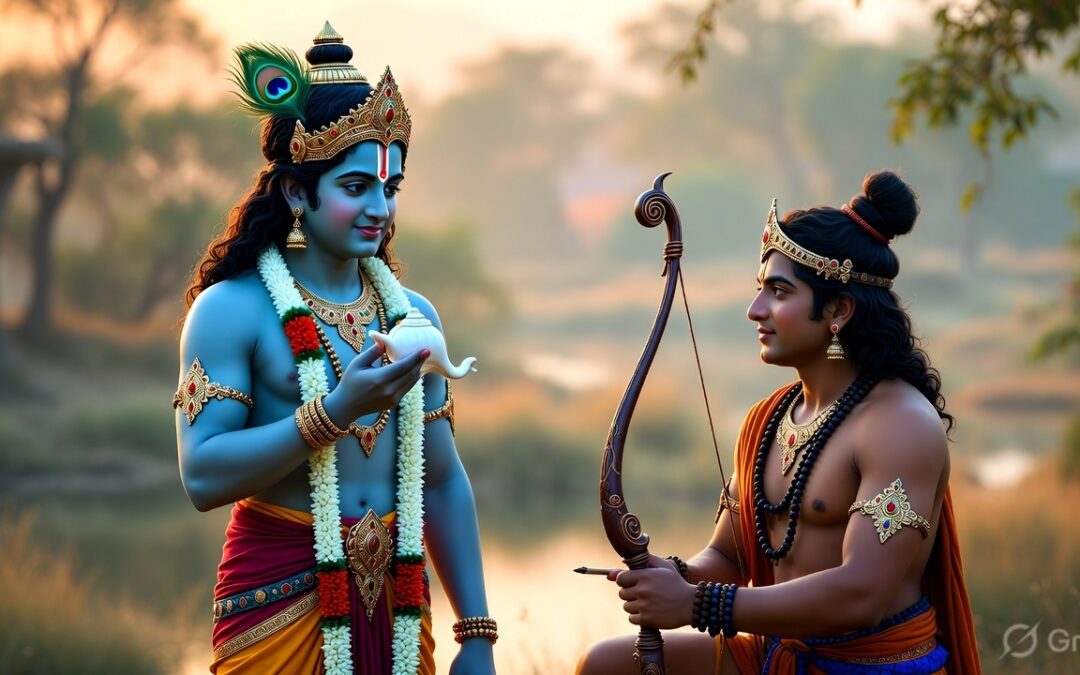
Journey into the Heart of Wisdom: Exploring Jnana Vijnana Yoga from the Bhagavad Gita
Have you ever wondered why some people seem to know all the facts about life but still feel lost, while others live with a quiet inner peace that nothing can shake? Imagine you’re on a battlefield, not just any battlefield, but the one inside your mind where doubts clash with decisions. That’s where Arjuna stood, confused and ready to give up, until his friend and guide, Bhagwan Krishna, shared a secret that changes everything. This secret is Jnana Vijnana Yoga, the path of knowledge and wisdom from Chapter 7 of the Bhagavad Gita. It’s like turning on a light in a dark room—first, you learn where the switch is (that’s jnana), and then you see the whole space clearly (that’s vijnana). Let’s dive into this timeless teaching, step by step, like friends chatting over chai, uncovering how it can light up our everyday lives.
The Roots in Ancient Wisdom: Where Does Jnana Vijnana Yoga Come From?
Picture this: The Bhagavad Gita is part of the epic Mahabharata, a grand story of heroes, villains, and the eternal battle between right and wrong. It’s set on the Kurukshetra battlefield, where Arjuna, a mighty warrior, faces his own family in war. Overwhelmed, he drops his bow and turns to Bhagwan Krishna, his charioteer and divine teacher. The Gita is their conversation—a guidebook for life drawn from ancient scriptures like the Vedas and Upanishads.
Chapter 7, called Jnana Vijnana Yoga or the Yoga of Knowledge and Wisdom, builds on earlier chapters where Bhagwan Krishna talks about action (karma yoga) and meditation (dhyana yoga). Here, He reveals the deeper truths about Himself and the universe. Drawing from the Upanishads, which explore the soul and the ultimate reality (Brahman), this chapter explains how everything in creation comes from Bhagwan Krishna’s energies. It’s not just theory; it’s a call to experience it.
In the Vedas, knowledge is sacred—it’s what separates illusion from truth. The Puranas, those colorful collections of myths and legends, often illustrate these ideas through stories of sages and gods. For instance, in the Bhagavata Purana, Sage Narada knows all the scriptures by heart, but it’s only through devoted practice and divine grace that he truly realizes the presence of Bhagwan Vishnu everywhere. That’s the shift from jnana (book knowledge) to vijnana (lived wisdom). This chapter echoes that: Bhagwan Krishna says in verse 7.2, “I shall now reveal unto you fully this knowledge and wisdom, knowing which nothing else remains to be known in this world.” Simple, right? But profound—like learning to ride a bike; first, you hear how, then you feel the balance.
Understanding Jnana and Vijnana: Knowledge vs. Realized Wisdom
Let’s break it down like explaining colors to a child. Jnana is like reading a map—it tells you where the treasure is. Vijnana is digging it up and holding the gold in your hands. In this chapter, Bhagwan Krishna describes jnana as understanding the divine nature intellectually: knowing that the soul is eternal, that the world is made of His energies, and that He’s the source of everything.
But vijnana goes deeper—it’s experiencing that truth in every moment. Why the difference? Because our minds are tricky, clouded by maya, Bhagwan Krishna’s illusory energy. Maya makes us chase temporary things like money or fame, forgetting the eternal. In verse 7.14, He explains, “My divine energy Maya, consisting of the three modes of nature, is very difficult to overcome. But those who surrender unto Me cross over it easily.” The three modes? Think of them as flavors: sattva (goodness, like fresh fruit), rajas (passion, like spicy curry), and tamas (ignorance, like stale bread). They mix in everything we do, creating confusion.
A lesser-known insight from commentaries like those in the Upanishads is that vijnana isn’t just personal enlightenment; it’s seeing Bhagwan Krishna in all creation. For example, in verse 7.7, He says, “There is nothing higher than Myself, O Arjun. Everything rests in Me, as beads strung on a thread.” Imagine a necklace—each bead is unique, but the thread holds them together. That’s us and the universe, threaded by the divine.
To illustrate, let’s recall a story from the Ramayana. When Bhagwan Ram needs to cross the ocean to rescue Maa Sita, the sea doesn’t part at first. It’s controlled by prakriti (nature), one of Bhagwan Krishna’s lower energies. Only when Bhagwan Ram asserts his divine will does it yield. This shows how material energy (jnana level) bows to spiritual realization (vijnana). In the Mahabharata itself, Duryodhana mocks Bhagwan Krishna during a peace talk, blind to His universal form. But Arjuna, through devotion, glimpses it later—that’s vijnana in action.
Also read: Dhyana Yoga Secrets
The Two Energies of the Divine: Material and Spiritual
Bhagwan Krishna reveals His two natures, like two sides of a coin. The lower energy (apara prakriti) is the material world—earth, water, fire, air, space, mind, intellect, and ego. It’s what we see and touch, but it’s temporary, like waves on the ocean. The higher energy (para prakriti) is the spiritual force, the souls that give life to everything. In verses 7.4-5, He says, “Earth, water, fire, air, space, mind, intellect, and ego—these are eight components of My material energy. But beyond it… I have a superior energy. This is the jīva śhakti (the soul energy).”
Why does this matter? Because we souls are part of that higher energy, trapped in the material by maya. Realizing this connects us to dharma (righteous duty) and karma (actions and their results). A deeper connection: In the Puranas, stories like the churning of the ocean (Samudra Manthan) show gods and demons pulling together to extract nectar (amrita, symbolizing eternal wisdom). The material (poison first) must be faced to reach the spiritual (nectar). It’s a metaphor for transcending maya through effort and grace.
Who Seeks This Wisdom? The Four Types of Devotees
Not everyone knocks on wisdom’s door. Bhagwan Krishna says in verse 7.3, “Amongst thousands of persons, hardly one strives for perfection; and amongst those who have achieved perfection, hardly one knows Me in truth.” It’s rare, like finding a pearl in the sea.
He describes four types of people who turn to Him:
- The distressed: Those in pain, seeking relief, like a child crying for help.
- The inquisitive: Seekers of knowledge, curious about life’s mysteries.
- The desirous: Wanting worldly success, like wealth or power.
- The wise: Those who know Him fully, merging their mind and intellect in Him.
The wise are dearest, as in verse 7.17: “Amongst these, I consider them to be the highest, who worship Me with knowledge… I am very dear to them and they are very dear to Me.” But even those worshiping other deities (devatas) indirectly reach Him, since all powers come from Bhagwan Krishna (verse 7.21). A lesser-known fact: In Vedic traditions, devatas like Bhagwan Indra or Maa Lakshmi are aspects of the Supreme, not separate. Worshiping them with pure intent purifies the heart, leading to ultimate realization.
On the flip side, four types don’t surrender: the ignorant, the lazy, the deluded, and the demonic. They chase illusions, missing the divine thread.
Also read: How Karma Sannyasa Yoga Transforms Your Life
Relevance to Modern Life: Practical Tips for Everyday Wisdom
In today’s fast world, Jnana Vijnana Yoga isn’t ancient dust—it’s a toolkit for peace. Stressed at work? Remember maya’s modes: Sattva helps with clear thinking, like eating fresh food or meditating. Rajas pushes ambition, but balance it to avoid burnout. Tamas leads to laziness—shake it off with action.
Practical tips:
- Start with jnana: Read a verse from the Gita daily. Explain it to yourself like to a friend.
- Build vijnana: Meditate on Bhagwan Krishna’s presence in nature—see Him in the taste of water (verse 7.8) or the sun’s light.
- Surrender ritual: Chant the mantra “Om Namo Bhagavate Vasudevaya” (from the Bhagavata Purana) to invoke grace. Do it in the morning, focusing on surrender.
- Do’s: Practice devotion with knowledge—volunteer, help others, seeing the divine in them.
- Don’ts: Avoid blind rituals; understand why you do them to turn jnana into vijnana.
Benefits? Spiritually, it awakens the soul, leading to moksha (liberation). Scientifically, studies show meditation (a vijnana practice) reduces anxiety and boosts focus—echoing how wisdom calms the mind’s battlefield. In daily life, it fosters ethical choices, aligning with dharma for better relationships and success.
Regional variations: In India, this chapter inspires festivals like Janmashtami, celebrating Bhagwan Krishna’s birth with Gita recitations. Globally, yoga classes often touch on it, blending Eastern wisdom with Western mindfulness.
Timeless Wisdom for Harmony and Awakening
As we wrap up, think of life as a grand tapestry woven by Bhagwan Krishna’s energies. Jnana Vijnana Yoga teaches us to see beyond the threads—to the weaver Himself. By surrendering, we transcend maya, embrace dharma, and let karma flow toward spiritual awakening. It’s a path to inner peace, where knowledge blooms into wisdom, fostering universal harmony. No matter your background, this yoga invites you to experience the divine in every breath. May it bring light to your journey, reminding us we’re all beads on that eternal thread.
Support us by purchasing from our Affiliate Links:
Jnana Yoga (Gyan Yoga) | A Guide to the Path of Enlightenment
The Book of Yoga: Karma Yoga, Bhakti Yoga, Raja Yoga, Jnana Yoga