

Advaita Vedanta Explained: Atman Equals Brahman in Ancient Wisdom
In a world filled with divisions—be it between people, nations, or even our inner thoughts—imagine discovering a philosophy that reveals everything as fundamentally one. This is the essence of Advaita Vedanta, an ancient Indian school of thought that has captivated seekers for centuries. At its heart lies the profound principle of the oneness of Atman and Brahman, a concept that challenges our everyday perceptions and invites us to explore the true nature of reality. As we dive into this topic, we’ll uncover how this non-dualistic view not only reshapes our understanding of the self but also offers timeless wisdom for living a more harmonious life.
Advaita, which literally means “not two,” emphasizes that there’s no ultimate separation in existence. It’s not just an abstract idea; it’s a transformative realization that has influenced countless spiritual traditions. Whether you’re new to Eastern philosophy or a seasoned explorer, grasping this principle can illuminate the path to inner peace. Let’s break it down step by step, exploring its origins, key elements, and practical implications.
The Foundations of Advaita Vedanta
Advaita Vedanta emerged as a distinct philosophy within Hinduism, drawing from the Vedas, the oldest sacred texts of India. It’s often credited to the eighth-century sage Adi Shankaracharya, who systematized its teachings through commentaries and discourses. However, its roots trace back even further to the Upanishads, philosophical dialogues composed between 800 and 200 BCE.
This school stands in contrast to dualistic philosophies that see a clear divide between the creator and creation, or the individual and the divine. Instead, Advaita asserts that reality is non-dual—there’s only one ultimate truth, and all apparent differences are illusions. Shankaracharya traveled across India, debating scholars and establishing monastic centers to spread this message, making it accessible beyond elite circles.
At the core is the rejection of multiplicity as the final truth. The world we see, with its joys and sorrows, is like a dream superimposed on an unchanging reality. This leads us to the two pivotal concepts: Brahman and Atman, whose oneness forms the bedrock of Advaita.
Also read: Navaratri 2025: Unlocking Spiritual Power and Inner Balance Through Nine Sacred Nights
Understanding Brahman: The Ultimate Reality
Brahman is described as the absolute, unchanging foundation of everything. It’s not a personal deity with form or attributes in the strictest sense, though it can be approached that way for devotional purposes. In Advaita, Brahman is nirguna—without qualities—yet it’s the source of all qualities we perceive in the universe.
Think of Brahman as pure existence itself, often characterized by the triad Sat-Chit-Ananda: Sat (eternal being), Chit (pure consciousness), and Ananda (infinite bliss). It’s omnipresent, beyond time and space, and unaffected by change. The Upanishads poetically describe it as “neti neti”—not this, not that—meaning it can’t be fully captured by words or concepts.
In everyday terms, Brahman is like the screen on which a movie plays. The scenes come and go, but the screen remains constant. Without Brahman, nothing could exist, yet it transcends all manifestations. This impersonal aspect might seem abstract, but Advaita also allows for saguna Brahman, a personalized form like Ishvara, the cosmic lord, to help devotees connect emotionally before realizing the deeper unity.
The Nature of Atman: The Inner Self
Shifting focus inward, Atman refers to the true self within each individual. It’s not the body, which decays, nor the mind, which fluctuates, nor the ego, which clings to identities. Atman is the eternal witness, the spark of consciousness that observes all experiences without being tainted by them.
In Advaita, Atman is immortal and indivisible. It’s the essence that makes you say “I am,” stripped of all labels like name, profession, or relationships. The challenge is that we often misidentify Atman with temporary aspects, leading to suffering. For instance, when we chase external validations, we’re forgetting that Atman is already complete.
Analogies help here: Atman is like the space inside a pot—seemingly limited by the pot’s shape, but truly boundless once the pot breaks. Or consider gold jewelry; rings and necklaces differ in form, but their substance is the same gold. Similarly, Atman appears varied across beings but is uniform in essence.
The Principle of Oneness: Atman Is Brahman
Now we arrive at the heart of Advaita—the declaration that Atman and Brahman are one and the same. This isn’t a merger of two entities; it’s the recognition that they were never separate. The famous Mahavakyas, or great sayings from the Upanishads, encapsulate this:
- “Tat Tvam Asi” (Thou art That) from the Chandogya Upanishad, pointing directly to the identity between the individual and the universal.
- “Aham Brahmasmi” (I am Brahman) from the Brihadaranyaka Upanishad, affirming personal realization.
- “Prajnanam Brahma” (Consciousness is Brahman) from the Aitareya Upanishad.
- “Ayam Atma Brahma” (This Self is Brahman) from the Mandukya Upanishad.
These statements aren’t mere affirmations; they’re tools for meditation to dissolve the illusion of duality. Shankaracharya explained this through the concept of superimposition: We mistakenly overlay limitations on the limitless, like seeing a snake in a rope at dusk. Once light dawns, the snake vanishes, revealing the rope. Similarly, realizing Atman as Brahman dispels the false sense of separation.
This oneness implies that every being is divine at the core. There’s no “other” to fear or hate because all is interconnected. It’s a radical shift from ego-centric views, fostering empathy and equanimity.
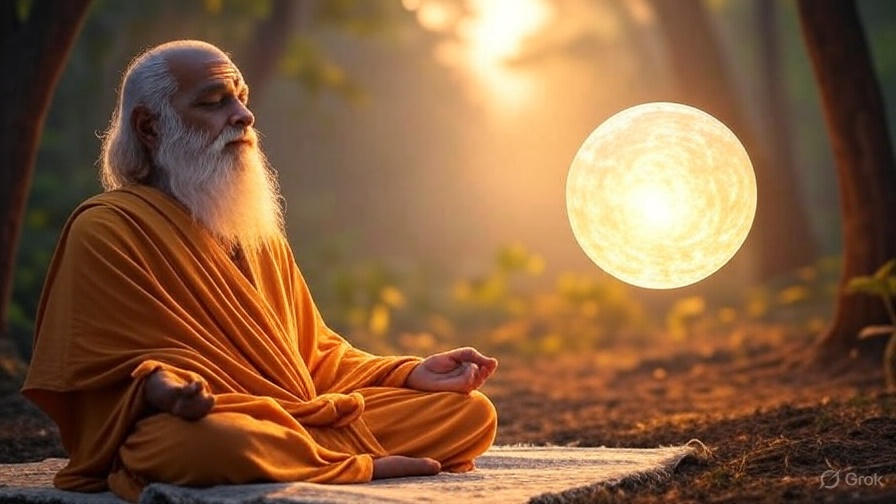
The Veil of Maya and the Grip of Avidya
If Atman and Brahman are one, why don’t we experience it? Enter Maya, the illusory power that creates the appearance of diversity. Maya isn’t evil; it’s a creative force of Brahman, like a magician’s trick that entertains but isn’t real. It projects the world of names and forms, making the one appear as many.
Closely tied is Avidya, or ignorance, which is personal and beginningless. Avidya causes us to identify with the body-mind complex, leading to desires, attachments, and the cycle of birth and death (samsara). It’s like wearing tinted glasses that distort reality—remove them, and clarity returns.
Shankaracharya used the dream analogy: In sleep, we create entire worlds that feel real until we wake. The waking world is similar—a projection sustained by ignorance. Overcoming Maya requires discernment (viveka) between the real (Brahman) and the apparent (world).
Key Texts and Influential Thinkers
Advaita’s teachings are rooted in the Prasthanatrayi—the triple canon:
- The Upanishads, mystical revelations exploring self and reality.
- The Brahma Sutras by Badarayana, a systematic aphoristic text reconciling Vedic ideas.
- The Bhagavad Gita, where Krishna teaches Arjuna about knowledge, devotion, and action leading to unity.
Shankaracharya’s commentaries on these texts are foundational, clarifying ambiguities and defending non-dualism against rivals like Mimamsa or Nyaya. Later thinkers like Gaudapada, his guru’s guru, advanced ideas in the Mandukya Karika, using logic to prove non-duality.
Sub-schools evolved, such as the Bhamati and Vivarana, debating nuances like the locus of ignorance, but all upheld the core oneness.
Also read: Unveiling the Divine Power: The Nine Forms of Goddess Durga During Navratri
The Path to Realization: Jnana Yoga
Realizing this oneness isn’t intellectual; it’s experiential. Advaita prescribes Jnana Yoga, the path of knowledge:
- Shravana: Listening to teachings from a qualified guru.
- Manana: Reflecting and reasoning to internalize them.
- Nididhyasana: Deep meditation to embody the truth.
Prerequisites include ethical living, detachment, and mental purity. Self-inquiry—”Who am I?”—is key, peeling away layers to reveal Atman. Liberation (moksha) is the end of ignorance, not a new attainment—it’s realizing what always was.
Relevance in the Modern World
In today’s fast-paced society, Advaita’s message resonates deeply. It counters materialism by reminding us that true fulfillment lies within, not in possessions. By seeing oneness, it promotes environmental stewardship—harming nature is harming oneself. In psychology, it aligns with mindfulness, reducing anxiety through non-identification with thoughts.
Globally, it fosters interfaith harmony, viewing all religions as paths to the same truth. Amid conflicts, this philosophy encourages compassion, recognizing the divine in everyone.
A Spiritual Message
As we conclude this exploration, remember: You are not a drop in the ocean; you are the entire ocean in a drop. Embrace this oneness, and let it guide your actions with love and wisdom. In moments of doubt, turn inward—the eternal Brahman awaits as your true Atman. May this realization bring you boundless peace and joy.