
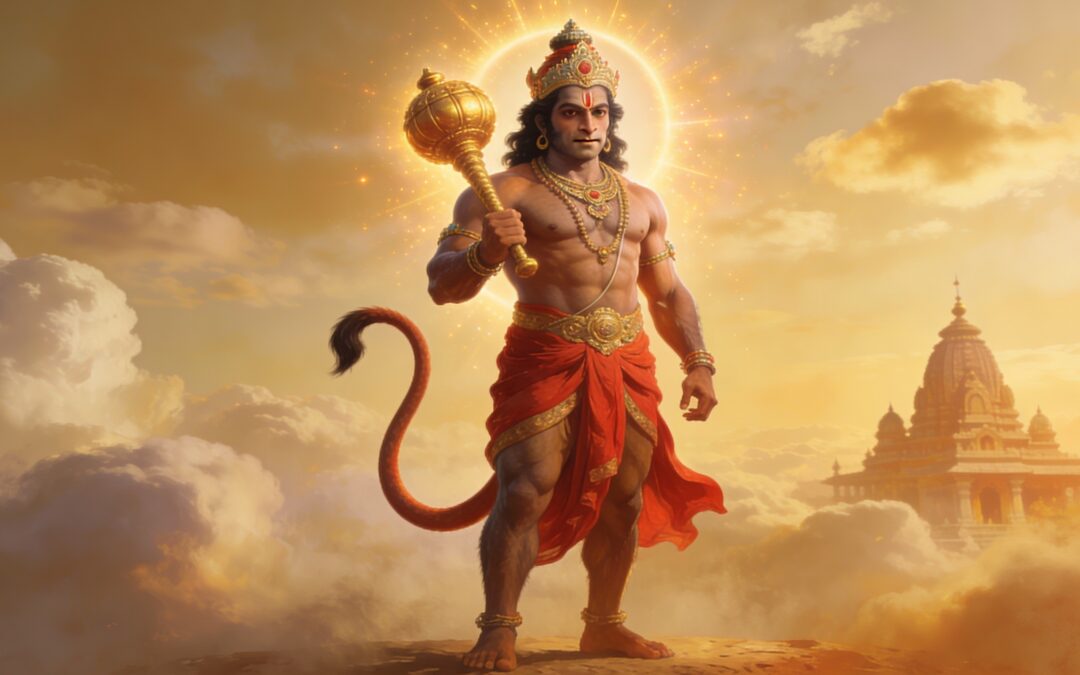
Lessons from Hanuman: Devotion, Strength, and Service
Imagine a young monkey, full of mischief and boundless energy, spotting a bright orange fruit hanging in the sky. Without a second thought, he leaps toward it, soaring higher and higher, only to crash back down after a thunderbolt from the heavens. That little monkey? It’s none other than Hanuman, the mighty vanara who would one day cross oceans and lift mountains. But here’s the twist: even with all his god-given powers, Hanuman never boasted. He simply said, “This isn’t my strength—it’s the grace of Bhagwan Ram.” In a world buzzing with selfies and success stories, Hanuman’s life whispers a timeless secret: true power blooms from quiet devotion, unyielding strength, and humble service. Let’s dive into the epic tales of the Ramayana and uncover these gems, stories that have lit the path for seekers across ages. Whether you’re a wide-eyed kid curious about ancient heroes or someone chasing inner peace amid modern chaos, these lessons from Hanuman are like a warm hug from the divine—simple, profound, and ready to transform your everyday.
The Roots of Hanuman’s Legend: A Glimpse into Ancient Wisdom
To understand Hanuman’s lessons, we must step back to the sacred scrolls of the Valmiki Ramayana, one of the grandest epics in Hindu granths. Composed by the sage Valmiki around the 5th century BCE, the Ramayana isn’t just a tale of adventure—it’s a mirror to dharma, the cosmic order that keeps the universe spinning in harmony. Hanuman appears like a shooting star in its Kishkindha Kanda and shines brightest in the Sundara Kanda, where his feats unfold like chapters in a divine playbook.
Hanuman’s birth itself is a story of divine intervention. Born to Anjana, a devoted apsara turned vanara by a curse, and Kesari, a noble monkey king, he was blessed by Bhagwan Shiva as his eleventh rudra avatar. But the real spark? Vayu, the wind god, infused him with life, making Hanuman his spiritual son—Pavanputra, swift as a gale. As a child, his hunger for knowledge led him to circle the sun chariot of Surya Bhagwan, learning the Vedas, Upanishads, and arts in a single orbit. Yet, a sage’s curse made him forget his powers until reminded, a gentle reminder from the granths that unchecked might can disrupt balance, much like karma’s subtle hand guiding our steps.
The Puranas, like the Shiva Purana and Ramayana’s own verses, weave in deeper threads. Hanuman embodies the jiva’s journey—the individual soul yearning for union with the paramatman, or supreme soul. In the Adhyatma Ramayana, he’s the bridge of bhakti, linking the heart to Bhagwan Ram. These texts aren’t dusty relics; they’re living breaths of wisdom, echoing the Bhagavad Gita’s call to act without attachment. Hanuman didn’t just live these truths—he danced through them, turning every leap into a lesson on surrender.
Stories That Echo Eternity: Hanuman’s Epic Feats
Nothing brings these lessons alive like the vivid kathas from the Ramayana. Let’s wander through a few, each one a sparkling thread in the tapestry of devotion, strength, and service. Picture the lush forests of ancient India, where monkeys chatter and rivers sing, as these events unfold.
Also read: Why Every Seeker Needs Shrimad Bhagavatam: Stories, Secrets, and Spiritual Awakening
The Ocean Leap: A Test of Unwavering Faith
In the Sundara Kanda, Bhagwan Ram’s beloved wife, Maa Sita, is abducted by the demon king Ravana and hidden in Lanka. The vanara sena, led by Sugriva, searches far and wide, but despair creeps in at the southern shore. Hanuman, feeling small amid the waves, slumps in doubt. Then Jambavan, the wise bear king, reminds him: “You are the son of Vayu, swift as thought itself. No task is too vast for you.” With those words, Hanuman’s forgotten powers surge back.
He swells to mountain size, then shrinks to pass a sea monster’s jaws, honoring her boon before slipping free—a clever nod to respect even in peril. Leaping across the churning ocean, he lands in Lanka, dodging demons and storms. There, in the Ashoka Vatika, he finds Maa Sita under a shady tree, her eyes heavy with sorrow. He whispers Bhagwan Ram’s message through a ring, offers to carry her home, but she refuses: “Only Ram’s hands can free me.” Hanuman doesn’t argue; he honors her wish, wreaks gentle havoc on the city to prove his might, then lets his tail be tied and lit aflame. As Ravana’s guards parade him, Hanuman stretches his tail into a fiery lasso, burning Lanka’s golden spires to ash—yet sparing the innocent.
This tale? It’s devotion in motion. Hanuman’s leap wasn’t for glory; it was for Bhagwan Ram’s smile. A lesser-known nugget from the Uttara Kanda: Hanuman inscribed Ram’s name on bridge stones, making them float and connect, while unmarked ones sank. Even nature bends to dedicated hearts.
The Mountain Lift: Strength Born of Care
Fast-forward to the Yuddha Kanda, the war’s thunderous heart. Lakshmana, Bhagwan Ram’s devoted brother, lies pierced by Indrajit’s arrow, his life flickering like a candle in wind. The only cure? The Sanjeevani herb from the distant Dronagiri mountain. Twilight falls, and Hanuman, racing against time, can’t spot the glowing plant among herbs. What does he do? In a burst of intuitive strength, he hoists the entire mountain onto his shoulder and flies back, reviving not just Lakshmana but the whole vanara army.
From the Ramayana’s verses, this feat highlights bala—strength—not as brute force, but as focused resolve. Tempted by illusory palaces en route (a trick by the asura Kalanemi), Hanuman stays true, guided by a wise crocodile’s warning. It’s a cosmic wink: true power awakens when aligned with dharma, turning obstacles into stepping stones.
Also read: Narada Bhakti Sutras Guide to Spiritual Awakening
The Chest’s Secret: Service from the Soul
After victory, at Ayodhya’s grand coronation, Maa Sita gifts Hanuman a pearl necklace. Teased by courtiers—”What’s so special about it?”—he snaps it open, jewel by jewel, finding no Ram within. Then, with a humble smile, he tears open his chest. There, etched in his beating heart, dwell tiny forms of Bhagwan Ram and Maa Sita, forever enshrined.
This poignant moment, drawn from Tulsidas’s Ramcharitmanas, reveals seva’s depth. Hanuman sought no throne, no riches—only eternal service. In the Mahabharata, he even humbles Bhima, his half-brother, by lifting his own tail like an unbreakable chain, teaching that ego-less aid outshines raw muscle.
These kathas aren’t fairy tales; they’re mirrors. Hanuman’s humility—destroying his own rock-carved Ramayana at Valmiki’s plea—shows how lesser-known acts of surrender weave into the grand design of karma and spiritual awakening.
The Heart of Devotion: Bhakti as Bhagwan Ram’s Eternal Flame
At devotion’s core is bhakti, the sweet surrender that turns ordinary lives divine. Hanuman’s bhakti to Bhagwan Ram was exclusive, like a river flowing only to one ocean. He saw Ram in every face, every task—prostrating to foes if they held Ram’s spark. The Upanishads echo this: the atman resides in all, awakened by pure love.
Lesser-known insight: Hanuman’s name means “one who conquered the mind” (han + man), slaying ahankara, the ego-dragon. In modern terms? It’s mindfulness without the app—focusing thoughts on the divine to quiet inner storms. Picture Hanuman chanting Ram’s name mid-leap; that’s your mantra for chaotic commutes.
Unleashing Strength: Bala Beyond the Body
Hanuman’s strength wasn’t gym-sculpted; it was soul-forged. Boons from devas made him fire-proof, weapon-proof, but they stirred only in Ram’s service. Jambavan’s reminder unlocked it, like flipping a divine switch. The Bhagavad Gita (Chapter 6) speaks of yogic control—steady mind as the ultimate might. Hanuman, the original yogi, taught pranayama, breath as Vayu’s gift, linking body to spirit.
Deeper layer: His panchamukhi form—five faces guarding directions—connects to cosmic order, warding off negativity like Shani’s gaze. For us? Strength means resilience: facing job loss with Ram’s grace, not rage.
The Joy of Service: Seva as Shared Divinity
Service, or seva, was Hanuman’s oxygen. He led armies, fetched herbs, guarded secrets—all without a “thank you” expected. In the Ramayana, he tells Vibhishana, “Serve Ram, and grace follows.” It’s karma yoga: act for the whole, detach from fruits.
A hidden gem from Puranas: Hanuman freed the Navagrahas from Ravana’s trap, balancing stars for all. Today, seva could be volunteering or a kind word—ripples of harmony in a divided world.
Hanuman in Today’s World: Practical Paths to Peace
These lessons aren’t locked in ancient caves; they pulse in our daily grind. Facing fear? Chant the Hanuman Chalisa Tuesdays or Saturdays—its 40 verses, penned by Tulsidas, invoke protection: “Bhoot pisach nikatt nahin aavai, Mahavir jab naam sunavai.” Start small: five minutes morning, letting words sink like roots.
For strength, try Surya Namaskar, Hanuman’s invention—12 poses saluting the sun, blending breath and bend for physical vigor. Science nods: yoga boosts endorphins, mirroring Hanuman’s boon-fueled vitality.
Service tip: Dedicate chores to Ram—washing dishes becomes an offering. Do’s: Approach with humility; don’ts: Seek credit. Benefits abound—spiritually, bhakti dissolves doubts, sparking awakening; scientifically, devotion lowers stress (studies link prayer to cortisol drops); everyday, it fosters empathy, mending family ties.
Regionally, Hanuman worship varies: fiery Hanuman Jayanti processions in North India, serene temple rituals in Tamil Nadu’s Namakkal. Globally, from Guyana’s Diwali reenactments to U.S. yoga studios chanting Chalisa, his vibe unites—over 10,000 temples worldwide, a testament to universal pull.
A Timeless Whisper: Harmony in Every Heartbeat
As the sun dips on Hanuman’s tales, remember: in a universe of fleeting wins, his legacy endures—chiranjeevi, forever chanting Ram’s name on Gandhamadana hills. Devotion binds us to the divine; strength lifts our loads; service knits souls. Like Hanuman’s fiery tail lighting Lanka’s dark, may these lessons ignite your path. In dharma’s embrace, find peace—not as escape, but as the quiet power to love fiercely, serve kindly, and soar unbound. Jai Shri Ram, Jai Hanuman—may harmony hum in your heart, a symphony for all.
Support us by purchasing from our Affiliate Links: