
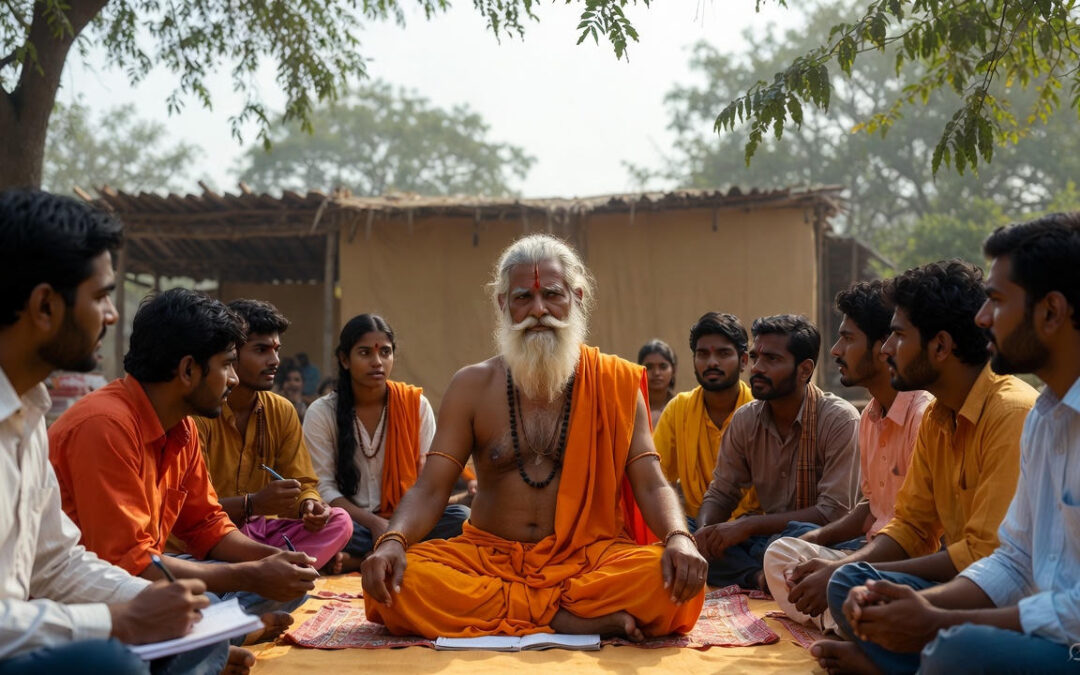
The Mandukya Upanishad: Unraveling the Eternal Echo of Om
Imagine sitting quietly by a flowing river at dawn, the first light of the sun kissing the water’s surface. You close your eyes, take a deep breath, and let out a single, resonant sound: Om. It starts as a gentle hum in your chest, rises like a wave, and fades into silence, leaving behind a profound stillness. In that moment, the boundaries between you and the world blur. The chatter of your mind quiets, and for a fleeting second, you touch something vast—something timeless. This is no ordinary sound; it’s the vibration of the universe itself, the sacred syllable that the ancient sages called the essence of all existence.
Welcome to the world of the Mandukya Upanishad, one of the most concise yet deeply mystical texts in Hindu spirituality. Tucked within the vast ocean of Vedic wisdom, this tiny Upanishad—just twelve short verses—holds the key to unlocking the mysteries of Om, or Aum. It’s like a seed that contains an entire tree: small in form, infinite in potential. In this blog, we’ll journey through its profound teachings, exploring how Om mirrors the rhythms of our consciousness and guides us toward spiritual awakening. Whether you’re a curious beginner dipping your toes into ancient wisdom or a seeker longing for deeper insights, let’s walk this path together, step by gentle step.
The Roots of Wisdom: A Glimpse into the Mandukya Upanishad
The Upanishads are the heart of the Vedas, those ancient scriptures whispered from guru to disciple under banyan trees thousands of years ago. Born from the Atharvaveda, the fourth Veda that deals with the mysteries of life and the cosmos, the Mandukya Upanishad stands out for its brevity. Composed around the 5th to 4th century BCE, it belongs to a lineage of texts that probe the ultimate reality—Brahman, the unchanging essence behind the ever-changing world.
Picture the rishis, those seers of old, meditating in forest hermitages. They didn’t just ponder the stars or the seasons; they turned inward, seeking the thread that connects the seen to the unseen. The Mandukya emerges from this quest, focusing solely on Om as the bridge between the individual soul (Atman) and the cosmic whole. Unlike the grand epics of the Ramayana or Mahabharata, which unfold through heroic tales, this Upanishad is pure philosophy—a direct arrow to the truth.
Its name, Mandukya, might evoke the image of a frog (manduka in Sanskrit), symbolizing the soul’s leap from the waters of illusion to the shores of enlightenment. Or it could nod to a Vedic school of thought, emphasizing disciplined inquiry. Whatever the origin, the text declares right at the start: “All this is Om.” Past, present, future, and even the timeless beyond—everything resonates within this single syllable. It’s said that meditating on the Mandukya alone can lead to moksha, liberation from the cycle of birth and death. No wonder the sage Gaudapada, in his famous commentary called the Karika, called it the pinnacle of Vedantic wisdom.
Also read: Isha Upanishad Revealed: How Ancient Wisdom Heals Modern Division
The Sacred Syllable: Decoding the Layers of Om
At the core of the Mandukya Upanishad lies Om, the primal sound from which creation sprang. In the Puranas, we hear echoes of this: Bhagwan Vishnu, the preserver, emerges from the cosmic waters on the hood of Shesha, with Om as the vibration that sustains the universe. But the Mandukya takes us deeper, dissecting Om into four parts: A, U, M, and the resounding silence that follows.
Think of Om as a musical note that unfolds like a flower. The ‘A’ is the open-mouthed beginning, vibrating in the throat like the awakening of dawn. The ‘U’ rolls in the middle, a sustaining hum in the chest, bridging day and night. The ‘M’ closes with lips pressed, a gentle fade into quiet, like twilight merging into stars. And then—ah, the magic—the silence, where the sound dissolves into pure awareness.
The Upanishad teaches that these four parts mirror the four states of consciousness, our inner worlds that we all traverse daily without realizing their sacred map:
- Vaishvanara: The Waking World (A) This is the outer-facing self, the Vaishvanara—the universal person—who experiences the gross, tangible world. Imagine a child chasing butterflies in a garden; eyes wide open, senses alive, tasting the sweetness of mangoes and feeling the sun’s warmth on skin. The verse describes it with seven limbs (the elements: space, air, fire, water, earth, plus ego and mind) and nineteen mouths (the senses and vital energies, or pranas). It’s the realm of action, where we eat, work, and play. But it’s limited, like a dream we mistake for reality.
- Taijasa: The Dreaming Realm (U) Turn inward, and you enter Taijasa, the brilliant one, where consciousness dances in subtle dreams. Here, no external sights or sounds intrude; instead, the mind weaves stories from memories and desires. Recall those vivid night visions—a flying adventure or a heartfelt reunion—that feel as real as daylight yet vanish on waking. The Upanishad likens it to a glowing fire, burning brightly but unseen from outside. It’s the bridge state, where karma from waking life ripens into inner experiences.
- Prajna: The Deep Sleep Sanctuary (M) Deeper still lies Prajna, the wise one, in dreamless sleep where all dissolves into bliss. No thoughts, no worries—just a profound rest, like sinking into a warm ocean of peace. The sages call it the causal body, the seed of all existence, where the knower, knowledge, and known merge into one. It’s ananda, pure joy, the quiet womb from which waking and dreaming emerge. In this state, we touch the divine without knowing it, refreshed each morning by its grace.
- Turiya: The Fourth, Beyond All (Silence) And now, the crown jewel: Turiya, the fourth state, symbolized by the silence after Om. Neither waking, dreaming, nor sleeping, it’s the witness to all three—the pure, non-dual awareness that Bhagwan is. Imagine standing on a mountaintop, where the valleys below (the three states) are seen but not felt as separate. Turiya is advaita—one without a second—tranquil, infinite, the true Atman. The Upanishad urges: “Not this, not that” (neti neti), pointing beyond words to direct realization.
Through these verses, the Mandukya weaves a tapestry of unity. The self in waking is the same as in dreaming, sleeping, and beyond— all Om, all Brahman. It’s a call to transcend the illusions of separation, aligning with dharma (righteous living) and understanding karma as the play of consciousness.
Echoes from the Ancients: Stories That Breathe Life into Om
While the Mandukya is more contemplative than narrative, its wisdom resonates in timeless tales from other Granths. Consider the Chandogya Upanishad, where a father teaches his son the dahara vidya—the small space within the heart where Om resides, vast as the cosmos. Or in the Bhagavad Gita, Bhagwan Krishna reveals to Arjuna: “I am Om, the sound in the Vedas” (Chapter 7, Verse 8), reminding us that the divine vibration pulses in every action.
A lesser-known gem comes from the Brahmanda Purana: Once, the devas and asuras churned the ocean of milk, and from it arose Om as the first sound, harmonizing chaos into creation. This myth illustrates Om‘s role in cosmic order (rita), where even opposing forces find balance. In regional lore from Kerala, Om is chanted during Theyyam rituals, invoking Mata Bhadrakali’s fierce protection, blending the Upanishad’s subtlety with vibrant folk devotion. Globally, from Tibetan chants to Sufi whirls, echoes of Om inspire seekers, showing its universal harmony.
Why It Matters Today: Om in the Chaos of Modern Life
In our fast-spinning world of notifications and deadlines, the Mandukya Upanishad feels like a lifeline. It reminds us that true peace isn’t in escaping life but in witnessing it—as Turiya watches the three states without attachment. Amid stress and burnout, understanding these layers fosters spiritual awakening: recognizing waking as a play, dreams as mental echoes, and sleep as renewal paves the way for mindful living.
Practically, chant Om daily to align with this wisdom. Start with five minutes: Sit comfortably, spine straight like a yogi’s tree. Inhale deeply, then exhale with Aaa… Uuu… Mmm, feeling the vibration rise from belly to crown. Let the silence linger, observing thoughts like clouds passing. Over time, this quiets the mind, sharpens focus, and deepens intuition—keys to navigating dharma in relationships and work.
Benefits That Bridge Spirit and Science
The Mandukya‘s gifts extend beyond the soul, touching body and mind:
- Spiritual Gains: Cultivates bhakti (devotion) and jnana (knowledge), dissolving ego for selfless service. It awakens kundalini energy, leading to bliss and cosmic connection.
- Everyday Perks: Boosts concentration for students or professionals; eases insomnia by honoring deep sleep; fosters empathy, reducing conflicts.
- Scientific Sparks: Studies show Om chanting slows heart rate, lowers cortisol (stress hormone), and synchronizes brain waves to alpha/theta states for creativity and calm. The vibration stimulates the vagus nerve, enhancing emotional regulation—proving ancient insight meets modern neuroscience.
Regional twists add flavor: In North India, Om Namah Shivaya blends it with Shaiva chants; South Indian temples echo it in Suprabhatam dawn prayers. Globally, yoga studios worldwide celebrate International Day of Yoga with Om sessions, uniting diverse hearts.
Also read: Unlocking the Cosmos: The Rig Veda’s Eternal Hymns to Nature’s Pulse and the Universe’s Rhythm
Chanting with Heart: Rituals, Mantras, and Gentle Guidance
To weave Om into life, embrace simple rituals rooted in respect. Begin with a clean space, perhaps facing east, honoring the rising sun. Light a diya (lamp) with ghee, symbolizing inner light.
- The Mantra Practice: Recite Om 108 times using a mala (prayer beads)—a sacred number echoing the Bhagavad Gita‘s cosmic cycles. For depth, meditate on the four states: Visualize A as your daily hustle, U as evening reflections, M as bedtime surrender, and silence as morning gratitude.
- Do’s for Harmony: Chant mindfully, with shraddha (faith); combine with pranayama (breath control) for amplified effects; share in satsang (spiritual gatherings) to amplify vibrations.
- Don’ts with Care: Avoid rushing—let it flow naturally; don’t force during illness, as rest is Prajna‘s gift; steer clear of skepticism, for doubt veils the light.
In festivals like Maha Shivaratri, devotees fast and chant Om through the night, mirroring the Upanishad’s transcendence. These aren’t rules but invitations to dance with the divine.
A Whisper of Eternity: The Timeless Call of Om
As our journey through the Mandukya Upanishad draws to a close, let its essence linger like the afterglow of Om. In a world pulling us apart—screens dividing attention, worries clouding joy—this ancient text offers a return home: to the silent witness within, where Atman and Brahman embrace. It teaches that every breath, every dream, every quiet moment is a step toward Turiya‘s peace, where karma dissolves into grace and dharma flows effortlessly.
May you, dear reader, find in Om not just a sound, but a symphony of the soul. Chant it softly tonight, and listen: the universe chants back. In this unity lies the promise of harmony—for you, for all beings, across time and space. Shanti, shanti, shanti—peace in body, mind, and spirit.
Support us by purchasing from our Affiliate Links: