
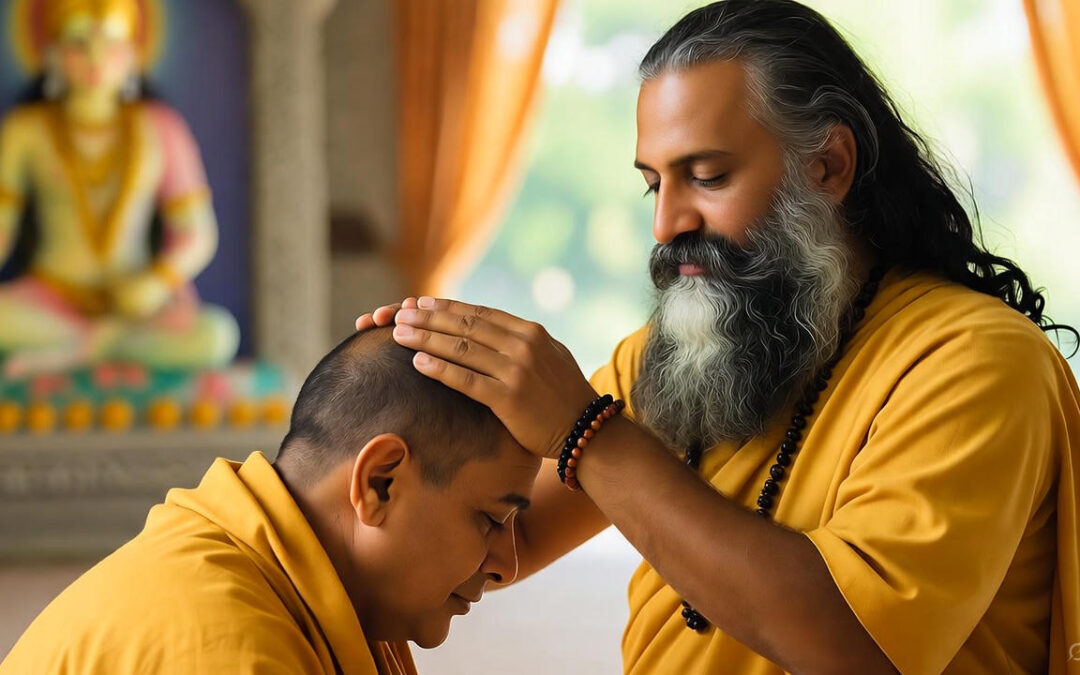
Why the Guru Is Your Guide to Spiritual Awakening in Hinduism
Introduction: The Light of Guidance in a World of Shadows
Imagine wandering through a dense forest, the path ahead unclear, with shadows dancing around you. Suddenly, a wise guide appears, holding a lamp that lights your way, showing you not just the path but also how to walk it with confidence. In Hindu spirituality, this guide is the Guru—a beacon of wisdom, compassion, and divine connection. The word “Guru” itself is profound, derived from Sanskrit roots “Gu” (darkness) and “Ru” (remover), meaning the one who dispels ignorance and leads us to the light of truth. But who is a Guru, and why is their role so central to Hindu spiritual life? In this blog post, we’ll explore the timeless significance of the Guru, weaving together ancient stories, sacred texts, and practical insights to understand their role in guiding us toward dharma, karma, and spiritual awakening.
The Guru in Hindu Scriptures: A Divine Connection
In Hindu tradition, the Guru is not just a teacher but a bridge to the divine. The Guru Gita, a sacred text found in the Skanda Purana, describes the Guru as the embodiment of Bhagwan Shiva, Bhagwan Vishnu, and Mata Shakti combined—a living channel to cosmic wisdom. The Upanishads, ancient texts of spiritual knowledge, emphasize that true wisdom (jnana) comes not from books alone but through the Guru’s guidance. In the Chandogya Upanishad (6.14.2), it is said, “Only through a Guru can one attain this knowledge; otherwise, it is impossible.”
The Guru’s role is also celebrated in the Bhagavad Gita. When Arjuna, confused and torn by his duties on the battlefield of Kurukshetra, turns to Bhagwan Krishna, he surrenders as a disciple, saying, “I am your disciple; instruct me” (Bhagavad Gita 2.7). Bhagwan Krishna, acting as Arjuna’s Guru, imparts timeless wisdom about dharma, karma, and the path to liberation (moksha). This sacred relationship shows that a Guru doesn’t just teach—they transform lives by aligning the disciple with the cosmic order.
Stories of Gurus: Lessons from Mythology
Hindu mythology is rich with stories that highlight the Guru’s transformative power. Let’s explore two such tales that bring this role to life.
The Story of Dattatreya: Learning from the Universe
Bhagwan Dattatreya, considered an incarnation of the Trimurti (Bhagwan Brahma, Vishnu, and Shiva), is a unique figure in Hindu spirituality. As a young seeker, Dattatreya wandered the world, observing nature and life. He declared that he had 24 Gurus—not humans, but elements of existence like the earth, sky, ocean, and even a tiny spider. From the earth, he learned patience; from the sky, vastness and detachment; from the spider, the art of creation and letting go. This story, found in the Bhagavata Purana, teaches us that a Guru can be anyone or anything that awakens wisdom. However, a human Guru helps us recognize these lessons and apply them to our spiritual journey.
Adi Shankaracharya and His Guru Govindapada
Adi Shankaracharya, the great philosopher who revived Advaita Vedanta, was guided by his Guru, Govindapada. As a young boy, Shankaracharya sought a teacher to understand the ultimate truth. He found Govindapada meditating in a cave by the Narmada River. When asked who he was, Shankaracharya replied with humility, seeking guidance. Govindapada tested his dedication, asking him to meditate deeply. Through his Guru’s teachings, Shankaracharya realized the non-dual nature of reality (Brahman) and went on to write profound commentaries on the Upanishads, Bhagavad Gita, and Brahma Sutras. This story illustrates the Guru’s role in unlocking a disciple’s potential, guiding them from curiosity to cosmic understanding.
Also read: Unlocking Shakti: The Power of Divine Feminine Energy in Hinduism
The Role of the Guru: Beyond Knowledge to Transformation
In Hindu spirituality, a Guru is much more than a teacher of facts. They are a spiritual guide, a mentor, and sometimes even a mirror reflecting our true selves. Here’s why the Guru is so significant:
- Dispeller of Ignorance: The Guru helps us see through maya (illusion), the veil that hides the truth of our divine nature. Like a lighthouse, they guide us past the storms of doubt and ego.
- Guide to Dharma: A Guru aligns us with dharma, the righteous path, helping us make choices that honor our purpose and the greater good.
- Karma and Liberation: By teaching us how our actions (karma) shape our destiny, a Guru shows the way to break free from the cycle of birth and death, leading to moksha.
- Personal Connection: Unlike books or rituals, a Guru tailors their teachings to the disciple’s unique needs, ensuring the path is practical and personal.
The Guru Gita (verse 17) beautifully sums this up: “The Guru is the creator, the Guru is the preserver, the Guru is the destroyer of ignorance. Salutations to that Guru.”
The Guru-Disciple Relationship: A Sacred Bond
The bond between a Guru and disciple (shishya) is one of trust, surrender, and mutual respect. In Hindu tradition, this relationship is sacred, often compared to a parent-child bond but with a spiritual purpose. The disciple approaches the Guru with humility, ready to learn, while the Guru imparts wisdom with compassion, never forcing but gently guiding.
A famous verse from the Mundaka Upanishad (1.2.12) advises, “To know the truth, approach a Guru who is learned in the scriptures and established in Brahman.” This highlights two qualities of a true Guru: deep knowledge and personal realization. A Guru isn’t just someone who knows the scriptures but one who lives their teachings, embodying dharma in action.
Rituals and Practices: Honoring the Guru
In Hindu tradition, the Guru is revered through specific rituals and practices, especially during festivals like Guru Purnima, celebrated on the full moon day in the month of Ashadha (June-July). Here are some ways to honor the Guru:
- Guru Puja: Offering flowers, fruits, and prayers at the Guru’s feet or to their image, symbolizing gratitude and devotion.
- Chanting Mantras: Reciting the Guru Mantra (e.g., “Om Guruve Namah”) or verses from the Guru Gita to invoke the Guru’s blessings.
- Service (Seva): Serving the Guru selflessly, whether through physical help or spreading their teachings, strengthens the disciple’s connection.
- Meditation and Reflection: Meditating on the Guru’s teachings or contemplating their guidance helps internalize wisdom.
Do’s and Don’ts:
- Do: Approach the Guru with humility, sincerity, and an open heart. Practice their teachings daily.
- Don’t: Treat the Guru as a mere human or expect instant results. Spiritual growth takes time and effort.
Also read: 5 Powerful Steps to Master Jnana Yoga for Spiritual Awakening
The Guru in Modern Life: Relevance and Practical Tips
In today’s fast-paced world, the Guru’s role remains as vital as ever. We face confusion, stress, and distractions that pull us away from our true selves. A Guru—whether a living teacher, a historical figure like Swami Vivekananda, or even the inner voice of wisdom—helps us find clarity and purpose. Here are some practical ways to connect with the Guru’s guidance in daily life:
- Seek Authentic Teachers: Look for Gurus whose lives reflect their teachings. In the digital age, many genuine spiritual masters share wisdom through books, talks, or online platforms.
- Apply Teachings Practically: If a Guru teaches compassion, practice small acts of kindness daily. If they emphasize meditation, dedicate 10 minutes each morning to stillness.
- Cultivate Inner Guru: The Yoga Vasistha teaches that the ultimate Guru is within. Through self-reflection and mindfulness, listen to your inner wisdom.
- Join Satsang: Participate in spiritual gatherings (satsang) to learn from collective wisdom and stay inspired.
Benefits of Following a Guru’s Guidance
The Guru’s guidance offers profound benefits, touching spiritual, mental, and even scientific dimensions:
- Spiritual Growth: A Guru helps us progress toward self-realization, aligning with the eternal truth (Satya).
- Mental Clarity: By reducing ego and confusion, a Guru fosters peace and focus, supported by studies showing meditation (often taught by Gurus) reduces stress.
- Moral Compass: The Guru’s teachings anchor us in dharma, guiding ethical decisions in a complex world.
- Community and Belonging: Following a Guru often connects us to a spiritual community, fostering a sense of unity and purpose.
Regional Variations and Global Impact
The reverence for Gurus is universal in Hinduism but varies across regions. In North India, Guru Purnima is a grand celebration with devotees honoring figures like Veda Vyasa, the compiler of the Vedas. In South India, temples dedicated to Gurus like Adi Shankaracharya host special rituals. Globally, the Guru’s significance resonates through movements like the teachings of Paramahansa Yogananda, whose book Autobiography of a Yogi introduced millions to the Guru-disciple tradition.
The Timeless Wisdom of the Guru
The Guru is a timeless guide, a lamp in the darkness of ignorance, leading us to the light of truth. Whether through ancient stories like Dattatreya’s universal learning or modern teachings that inspire mindfulness, the Guru’s role is to awaken us to our divine potential. As the Taittiriya Upanishad reminds us, “The Guru is the boat that carries us across the ocean of samsara (worldly existence).” By embracing their wisdom with humility and dedication, we align with dharma, transform our karma, and move closer to universal harmony.
Let us honor the Guru—not just as a person but as the eternal principle of guidance that exists in every heart, every sunrise, and every moment of awakening. May we walk the path they light with courage, love, and peace.
Support us by purchasing from our Affiliate Links: