
5 Powerful Steps to Master Jnana Yoga: Knowledge as a Means to Liberation
Imagine sitting under a sprawling banyan tree, its roots weaving stories of ancient wisdom, as a gentle breeze carries whispers of truth. This is the essence of Jnana Yoga—the path of knowledge that leads to liberation. Unlike physical postures or devotional chants, Jnana Yoga invites us to dive deep into the mind, question reality, and discover the eternal truth that lies within. It’s a journey for the curious, the seeker, and the soul yearning to understand the universe and its place in it. In this blog post, we’ll explore the profound path of Jnana Yoga, its roots in Hindu philosophy, its practices, and how it can guide us toward moksha (liberation) in today’s fast-paced world.
What is Jnana Yoga?
Jnana Yoga, often called the “path of knowledge,” is one of the four primary paths of yoga described in Hindu scriptures, alongside Bhakti Yoga (devotion), Karma Yoga (selfless action), and Raja Yoga (meditation). The word “Jnana” comes from the Sanskrit root “jna,” meaning “to know.” But this isn’t about memorizing facts or mastering trivia. Jnana Yoga is the pursuit of self-realization through wisdom, discernment, and a deep inquiry into the nature of reality.
At its core, Jnana Yoga seeks to answer life’s biggest questions: Who am I? What is the universe? What is real, and what is illusion? It teaches that our true self, the Atman, is one with Brahman, the ultimate reality, and that ignorance (avidya) is the only barrier to realizing this truth. By peeling away layers of illusion, Jnana Yoga leads to moksha—freedom from the cycle of birth and death.
The Bhagavad Gita, a timeless spiritual guide, emphasizes Jnana Yoga in chapters like the second and fourth, where Bhagwan Krishna explains to Arjuna the importance of self-knowledge and discernment. Similarly, the Upanishads, ancient texts of wisdom, form the foundation of Jnana Yoga, urging seekers to realize, “Aham Brahmasmi”—I am Brahman.
The Roots of Jnana Yoga in Ancient Scriptures
Jnana Yoga finds its roots in the Vedas, the oldest sacred texts of Hinduism, particularly in the Upanishads, which are also called Vedanta (the “end of the Vedas”). These texts explore the nature of existence and the unity of the individual soul with the cosmic consciousness. The Mundaka Upanishad, for instance, distinguishes between two types of knowledge: lower knowledge (material sciences) and higher knowledge (self-realization). Jnana Yoga focuses on the latter, guiding us to understand the eternal truth beyond the physical world.
The great sage Adi Shankaracharya, an 8th-century philosopher, was a key figure in shaping Jnana Yoga through his teachings of Advaita Vedanta, a non-dualistic philosophy. He taught that the world we perceive is maya (illusion), and only Brahman is real. His famous saying, “Brahma satyam, jagat mithya” (Brahman is truth, the world is false), encapsulates the essence of Jnana Yoga. Shankaracharya’s commentaries on the Upanishads, Bhagavad Gita, and Brahma Sutras remain guiding lights for Jnana yogis.
A beautiful story from the Chandogya Upanishad illustrates this path. A young boy, Svetaketu, returns home after years of studying the Vedas, proud of his knowledge. His father, Uddalaka, asks him, “Do you know that by which all else is known?” Confused, Svetaketu admits he doesn’t. Uddalaka then teaches him about the unity of the self and Brahman, using the analogy of clay: just as all pots are made of clay, all things in the universe are manifestations of Brahman. This story captures the heart of Jnana Yoga—knowledge that transcends the superficial to reveal the oneness of existence.
The Four Pillars of Jnana Yoga
Jnana Yoga is not about reading books or debating philosophy; it’s a disciplined practice that requires a pure heart and a sharp mind. According to Advaita Vedanta, there are four essential practices, known as Sadhana Chatushtaya, to prepare for this path:
- Viveka (Discrimination): This is the ability to distinguish between the real (Brahman) and the unreal (the material world). Imagine you’re walking in a forest at dusk and mistake a rope for a snake. Viveka is the clarity to see the rope for what it is, dispelling fear and illusion.
- Vairagya (Detachment): Detachment doesn’t mean abandoning life but letting go of attachment to fleeting things—wealth, status, or even emotions. It’s like watching a movie without getting lost in the drama, knowing it’s temporary.
- Shatsampatti (Six Virtues): These include discipline of the mind (shama), control of the senses (dama), withdrawal from distractions (uparati), endurance (titiksha), faith in the scriptures and guru (shraddha), and focus (samadhana). Together, they create a calm and focused mind ready for inquiry.
- Mumukshutva (Intense Desire for Liberation): This is the burning yearning to be free from the cycle of birth and death. Without this longing, Jnana Yoga remains an intellectual exercise rather than a transformative journey.
These pillars prepare the seeker for the core practice of Jnana Yoga: self-inquiry (atma-vichara), which involves questioning, “Who am I?” and meditating on the nature of the self.
The Practice of Self-Inquiry
The most famous method of Jnana Yoga is self-inquiry, popularized by the 20th-century sage Ramana Maharshi. He taught that by constantly asking, “Who am I?” we peel away layers of false identity—our body, thoughts, emotions, and roles—until we realize the pure consciousness that remains.
Let’s try a simple version of this. Close your eyes and ask, “Who am I?” You might think, “I’m a student, a parent, a friend.” But these are roles, not your essence. Go deeper: Are you your thoughts? Your body? Your emotions? With practice, you realize you are the awareness observing these things, unchanging and eternal. This is the Atman, one with Brahman.
The Kena Upanishad beautifully describes this: “The eye does not see itself, the knife does not cut itself, the fire does not burn itself.” Similarly, the self is the knower, not the known. Through meditation, study of scriptures, and guidance from a guru, Jnana yogis seek to abide in this truth.
The Role of a Guru and Scriptures
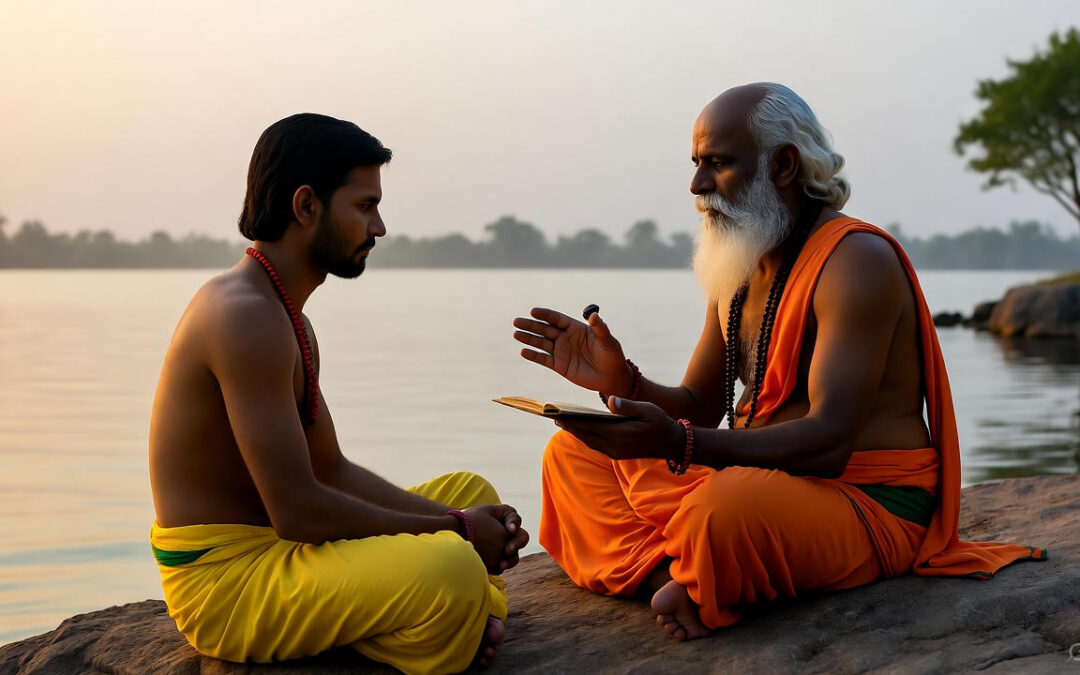
Jnana Yoga emphasizes Shravanam (listening), Mananam (reflection), and Nididhyasanam (meditation). A guru plays a vital role in guiding seekers through these steps. By listening to the guru’s teachings or studying texts like the Upanishads or Bhagavad Gita, we gain clarity. Reflection helps us internalize these truths, and meditation allows us to experience them directly.
For example, in the Katha Upanishad, young Nachiketa questions Yama, the deity of death, about the nature of the self. Yama explains that the self is eternal, beyond birth and death, and can only be known through wisdom. This dialogue underscores the importance of a teacher who can unravel complex truths in a way that resonates with the seeker.
Relevance of Jnana Yoga in Modern Life
In today’s world of distractions—endless notifications, social media, and material pursuits—Jnana Yoga offers a path to inner peace and clarity. It teaches us to question what truly matters and find meaning beyond the chaos. By practicing discernment, we can make wiser choices, avoid getting swept away by trends, and live in alignment with dharma (righteous duty).
Jnana Yoga also has scientific parallels. Modern neuroscience shows that mindfulness and self-reflection can reduce stress and improve mental clarity. By understanding our true nature, we cultivate resilience, compassion, and a sense of purpose—qualities that benefit both individuals and society.
Practically, you can incorporate Jnana Yoga into daily life by:
- Reading Scriptures: Spend a few minutes daily with texts like the Bhagavad Gita or Upanishads, reflecting on their teachings.
- Mindful Inquiry: Pause during the day to ask, “Who is experiencing this moment?” This simple question can ground you in awareness.
- Meditation: Dedicate time to silent contemplation, focusing on the self beyond thoughts.
- Journaling: Write about your beliefs and question their origins to deepen self-understanding.
Rituals and Mantras in Jnana Yoga
Unlike Bhakti Yoga, Jnana Yoga is less about rituals and more about inner work. However, some practitioners use mantras like “Om Tat Sat” (That is the Truth) or “Aham Brahmasmi” to focus the mind. Chanting these mantras during meditation can help internalize their meaning. Additionally, studying scriptures under a guru’s guidance is considered a sacred practice.
A lesser-known practice is Neti-Neti (not this, not that), where you systematically reject false identities. For example, “I am not my body, I am not my mind, I am not my emotions.” This helps narrow down to the true self.
Benefits of Jnana Yoga
- Spiritual Growth: Realizing the unity of Atman and Brahman brings profound peace and freedom from fear.
- Mental Clarity: Discernment sharpens decision-making and reduces confusion.
- Emotional Resilience: Detachment from fleeting pleasures fosters inner stability.
- Universal Connection: Understanding oneness cultivates compassion and harmony.
Regional and Global Variations
Jnana Yoga is practiced worldwide, especially in Advaita Vedanta communities. In India, ashrams like those of Ramana Maharshi in Tamil Nadu or Adi Shankaracharya’s Sringeri Math in Karnataka are hubs for Jnana Yoga. Globally, spiritual seekers explore Jnana Yoga through meditation retreats, online courses, and study groups, adapting its principles to modern lifestyles.
Challenges and Do’s and Don’ts
Jnana Yoga is not easy—it requires discipline, humility, and patience. Here are some tips:
- Do: Study authentic scriptures, seek a qualified guru, and practice self-inquiry daily.
- Don’t: Get lost in intellectual debates or confuse knowledge with ego. Jnana Yoga is about direct experience, not just theory.
The Timeless Wisdom of Jnana Yoga
Jnana Yoga reminds us that true liberation lies within. Like the lotus that blooms above muddy waters, we can rise above illusions to discover our divine essence. This path teaches us to live with wisdom, compassion, and purpose, creating a ripple effect of peace in the world. As the Mundaka Upanishad says, “He who knows Brahman becomes Brahman.” May we all walk this path with curiosity and courage, finding the eternal truth that unites us all.
Support us by purchasing from our Affiliate Links:
The Holy Vedas: A Guide to the Philosophies of Hinduism
Vedas & Upanishads: Greatest Spiritual Wisdom for Tough Times