
Exploring Time Cycles and Divine Birth Secrets in the Creation Story of the Puranas
The creation story in the Puranas is one of the most captivating aspects of Hindu mythology. These ancient texts, like the Vishnu Purana, Bhagavata Purana, and Skanda Purana, paint a picture of how the universe came into being through divine will and endless cycles. Unlike a single event, the Puranas describe creation as a repeating process guided by Bhagwan Vishnu, Bhagwan Brahma, and Bhagwan Shiva. This cosmic evolution involves a vast ocean, a golden lotus, and the birth of all beings, reminding us of the interconnectedness of everything. Let’s dive into this timeless narrative, step by step, to understand the profound wisdom it holds.
The Primordial State: From Darkness to Divine Rest
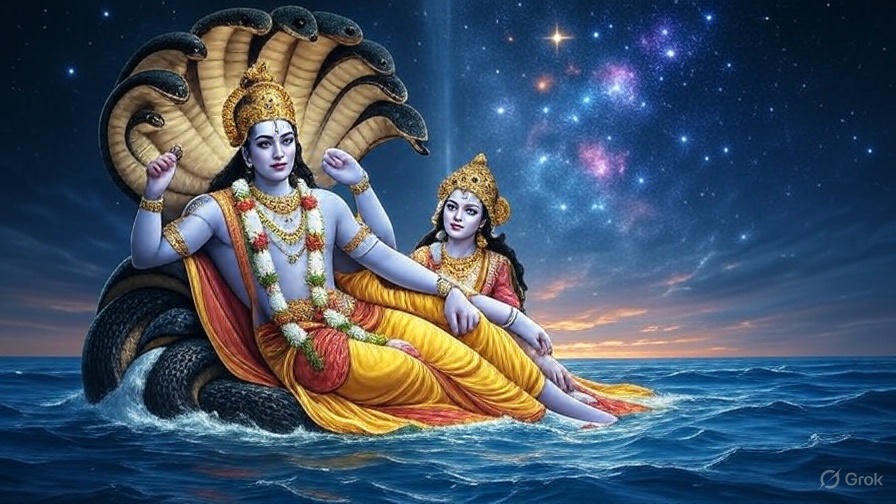
Before the universe as we know it existed, there was only a vast, formless void known as pralaya—the time of dissolution. In this endless darkness, nothing moved, and all creation rested in potential. The Puranas, such as the Vishnu Purana, describe Bhagwan Vishnu, the eternal preserver, lying in deep slumber on the great serpent Ananta Shesha. Ananta Shesha floats on the cosmic ocean called Kshir Sagar, a milky sea symbolizing purity and infinity.
Mata Lakshmi, the goddess of wealth and grace, attends to Bhagwan Vishnu, massaging his feet with devotion. She represents the nurturing energy that supports all life. This state is not emptiness but a pregnant pause, where the divine gathers strength for the next cycle of creation. The Bhagavata Purana explains that this pralaya happens at the end of each kalpa, a massive time period, allowing the universe to renew itself eternally.
The Birth of Bhagwan Brahma: The Lotus from Bhagwan Vishnu’s Navel
From Bhagwan Vishnu’s navel emerges a radiant golden lotus, shining like a thousand suns. This lotus, often called the Hiranyagarbha or golden womb, holds the seed of the cosmos. Inside it, Bhagwan Brahma is born—self-manifested and without parents. With four faces gazing in all directions, Bhagwan Brahma symbolizes infinite knowledge and the power to create.
Confused at first, Bhagwan Brahma wonders about his origin and purpose. He descends the lotus stem, searching for its root, only to discover it leads back to Bhagwan Vishnu. In the Vishnu Purana, a divine voice instructs him to begin creation. This moment marks the start of cosmic evolution, where the formless becomes form. The lotus represents purity rising from the depths, a common theme in Hindu creation myths.
Also read: Understanding Pitru Paksha: Rituals, Stories, and Significance
Bhagwan Brahma’s Act of Creation: Elements, Beings, and Balance
Empowered by divine will, Bhagwan Brahma sets to work. He first creates the fundamental elements that form the building blocks of the universe. From his mind springs mahat-tattva, the principle of intelligence. Then come the five great elements: akasha (space), vayu (air), agni (fire), jala (water), and prithvi (earth). These mix to shape the physical world, as detailed in the Garuda Purana.
Next, Bhagwan Brahma populates the cosmos. He creates the devas, celestial beings like Indra (king of heavens), Agni (fire god), and Varuna (water god), who dwell in higher realms. To maintain balance, he also brings forth asuras, powerful beings embodying chaos and challenge. The Puranas emphasize that asuras, though often in conflict with devas, are essential for the cosmic drama.
Humans and other creatures follow. The first human, Manu, is created as the progenitor of mankind. From Manu descend various races and societies. Animals, birds, plants, and even insects emerge, each with a specific role. For instance, cows provide sustenance, elephants embody strength, and trees offer shade and fruit. The Skanda Purana describes Bhagwan Brahma creating mind-born sons like Marici and Daksha, who further propagate life.
In some accounts, Bhagwan Brahma divides himself into male and female forms to create Viraj and Shatarupa, the first couple. This highlights the Puranic view of creation as an act of division from unity, echoing deeper philosophical ideas.
The Cosmic Egg: Hiranyagarbha and the Golden Womb
A key symbol in the creation story in the Puranas is the Hiranyagarbha, the cosmic egg. In the Garuda Purana, the universe begins as an expanse of water where a golden egg forms. Bhagwan Vishnu places the seed of creation inside, and Bhagwan Brahma emerges from it to shape the world.
This egg represents the universe’s potential—containing all matter, energy, and life. It breaks open to reveal the fourteen lokas (worlds), from heavenly realms to the underworlds. The Bhagavata Purana describes the Brahmanda (cosmic egg) as a geocentric structure, enveloped in seven layers: earth, water, fire, air, sky, total energy, and false ego. Each layer is ten times thicker than the previous, emphasizing the vastness of creation.
The Hiranyagarbha ties into the idea of maya, the illusion that makes the one appear as many. Ultimately, everything traces back to Brahman, the supreme reality beyond form.
The Role of Bhagwan Shiva: Destruction for Renewal
While Bhagwan Brahma creates and Bhagwan Vishnu preserves, Bhagwan Shiva ensures destruction, clearing the path for new beginnings. In the Skanda Purana, Bhagwan Shiva is the supreme lord who conceives the universe and creates Bhagwan Brahma from his right side and Bhagwan Vishnu from his left. This Shaivite perspective shows variations in Puranic stories, where different texts highlight different deities.
Bhagwan Shiva’s consort, Mata Parvati (also Maa Durga or Maa Kali), embodies the dynamic energy of creation and destruction. His cosmic dance, the Tandava, dissolves the universe during pralaya. Stories like the defeat of asuras by Bhagwan Shiva or his avatars underscore that destruction is compassionate, making way for fresh creation.
Also read: The Hidden Lessons of Bhagwan Ganesha Elephant Head and More
Time Cycles in the Puranas: Yugas, Kalpas, and Eternal Renewal
The Puranas don’t see time as linear but as vast, repeating cycles. The smallest unit is a yuga, with four ages:
- Satya Yuga: Era of truth and purity, lasting 1,728,000 years.
- Treta Yuga: Virtue declines slightly, 1,296,000 years.
- Dvapara Yuga: Challenges increase, 864,000 years.
- Kali Yuga: Current age of conflict, 432,000 years.
A mahayuga comprises these four, totaling 4.32 million years. Seventy-one mahayugas form a manvantara, ruled by a Manu. Fourteen manvantaras make a kalpa, one day in Bhagwan Brahma’s life—4.32 billion years. At kalpa’s end, a partial pralaya occurs, often by fire or flood.
Bhagwan Brahma’s full life is 100 years (311 trillion human years), ending in mahapralaya, total dissolution. Then, a new cycle begins. The Bhagavata Purana links these to cosmic evolution, teaching impermanence and the value of devotion in Kali Yuga.
Narad Muni, the wandering sage, often appears in these tales, sharing wisdom across realms. In one story, he questions Bhagwan Brahma about creation, learning that even creators are instruments of higher forces.
Variations in Creation Stories Across Puranas
The creation story in the Puranas isn’t uniform—each text offers unique angles. The Vishnu Purana emphasizes Bhagwan Vishnu as the source, with Purusha (Brahma) as part of him. Shaivite Puranas like the Skanda highlight Bhagwan Shiva’s primacy. The Devi-Bhagavata Purana involves Maa Shakti as the creative force.
Some accounts start with a golden egg in waters, others with Bhagwan Shiva’s will. These variations reflect Hinduism’s diversity, accommodating different devotional paths while pointing to the same ultimate truth.
Lessons from the Puranic Creation Story
This narrative inspires wonder, showing the universe as a divine play. It mirrors modern concepts like the Big Bang or evolutionary cycles but adds a spiritual layer—everything is sacred, infused with divine energy. In tough times, remembering Bhagwan through bhakti offers solace.
What are your thoughts on the creation story in the Puranas? Does it resonate with your understanding of the universe? Share in the comments below!
Support us by purchasing from our Affiliate Links: